Guineas weekend. Every hotel bed in Newmarket is taken, the pubs off the High Street have queues out of the door, and somebody standing on the pavement with a phone types restaurants Newmarket. Three places come back on a small map. Those three have a very good Saturday. Everyone else has a normal one. Our guide to web design for restaurants and pubs covers what those three get right.
That is the town in miniature: an international name attached to a very small search market. This is a guide to web design in Newmarket that local businesses can actually use. What a site here has to do that a site in Cambridge does not, why a CB8 postcode quietly confuses local search, what the racing calendar should do to your content, and what the whole thing costs.
It is written as much for the dentist, the letting agent and the garage as for the yards and the studs. The principles are identical. The searches are not, and that is where most websites in this town go wrong.
Key takeaways
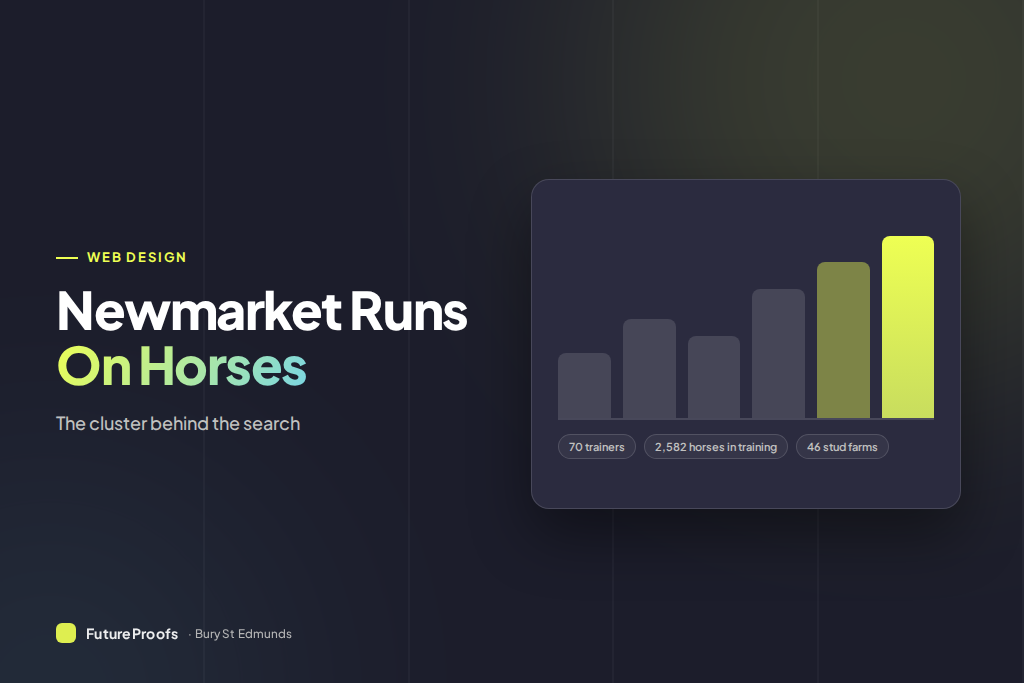
- West Suffolk Council's 2022 study of the horse breeding and racing cluster counted around 70 trainers, 2,582 horses in training and 46 stud farms in and around Newmarket, supporting roughly 3,285 jobs.
- Newmarket is in Suffolk but carries a CB8 Cambridge postcode, so your address needs to say the county out loud on every listing you own.
- A separate page for each village you serve beats one paragraph that names ten of them, because a page can rank and a sentence cannot.
- Seasonal pages need publishing six to eight weeks before the meeting, not during it, because a new page takes weeks to be indexed and trusted.
- FutureProofs website plans are from £189 a month with hosting, unlimited edits and the monthly search work included rather than billed as a separate retainer.
Why a Newmarket website has to serve two towns at once
Most local websites have one job: be the nearest credible option when somebody close by searches. In Newmarket that is half the work, because a large slice of the local economy does not buy locally at all.
The town that lives here all year
The residents need what any market town needs. A plumber, a dentist, a dog groomer, an MOT, somewhere to eat on a Friday. Those searches are settled mostly by proximity and by your Google Business Profile, and your website's job is to back the profile up: prove you are real, say what you charge, and put the phone number one tap away.
The trade that buys from anywhere
Then there is the other Newmarket. The cluster study above describes an industry concentrated into a few square miles and generating around £256m of gross value added, and the people spending money in it are frequently nowhere near Suffolk. A bloodstock agent in Kildare looking for a pre-purchase examination. An owner in Hong Kong choosing a rehabilitation yard. A syndicate manager comparing horse transport for a runner at Chantilly. None of them is doing a near me search. They search by capability, by discipline and by name, usually on a laptop, and they read the credentials pages properly before they pick up a phone.
Those two audiences want different pages, different proof and different words. A home page that tries to greet both usually greets neither. The fix is not a bigger home page. It is more pages, each aimed at one job and one reader.
The CB8 problem: a Suffolk business with a Cambridge postcode
Newmarket sits in Suffolk, in the West Suffolk district. Its postcode is CB8, which belongs to the Cambridge postcode area, and the dialling code is 01638. That administrative oddity does quiet damage, because directories, form validators, aggregators and customers all resolve it differently. Half your listings end up saying Cambridgeshire. Some say Suffolk. A few say nothing at all.
Search engines reconcile your name, address and phone number across everything they find, and inconsistency makes them hesitate. Four fixes, none costing money.
- Pick one address format and never vary it. Decide on the exact wording, county included, and use it identically on your website footer, your Google Business Profile, Companies House, your invoices, your quotes and every directory you have ever filled in.
- Say the county in your copy. Newmarket, Suffolk, written in plain text on the contact page and in the footer, removes the ambiguity for both a person and a crawler.
- Do not try to be a Cambridge business. Cambridge is thirteen miles and a completely different competitive set away, and a Newmarket firm chasing Cambridge head terms usually ends up ranking for neither.
- Build a page for each place you actually work. Exning, Kentford, Cheveley, Moulton, Ashley, Stetchworth and Dullingham on the Suffolk side. Burwell, Fordham, Soham and Bottisham over the Cambridgeshire line. A page can rank for a village. A sentence listing eleven of them ranks for none.
This is the part of the job that looks like admin and behaves like advertising. It is the backbone of how we approach local search work around Newmarket, and the villages we build pages for are set out on the areas page.
The web design Newmarket businesses actually need, page by page
Almost every underperforming site here has the same shape: home, about, services, contact. Four pages, and only one can rank for anything specific. Here is the structure that works instead, in build order.
| Page | What it is for | When to build it |
|---|
| Home | Says what you do, who for and where, above the fold. Not a mission statement. | First |
| One page per job you are paid to do | Matches the exact thing a customer types, and gives an AI something concrete to quote. | First month |
| Prices, or honest from prices | Filters out the enquiries you do not want and wins trust from the ones you do. | First month |
| Who you are, with names and faces | Answers the question behind every enquiry: who will actually turn up. | First month |
| One page per village or town you cover | Wins the searches that carry a place name, which are the ones with intent. | Second month |
| Reviews, written into the page | An embedded widget can be invisible to a crawler. Quoted text is not. | Ongoing |
| Contact, with map, hours and a tap to call | Removes the last bit of friction on a phone in a car park. | First |
Write pages for jobs, not categories
A farrier does not sell farriery. He sells remedial shoeing, hot shoeing, hunters through the winter, road work, and emergency lost shoes on a Sunday. An equine vet does not sell veterinary services. She sells pre-purchase examinations, lameness workups, dentistry, endoscopy and stud work. A feed merchant sells delivery routes as much as feed. Every one of those is a search, and every one of them deserves its own page with its own heading, its own price guidance and its own answer to the question a customer is really asking, which is usually how fast can you get here and what will it cost.
The same logic applies off the Heath. A garage needs a page for MOTs, one for cambelts, one for diagnostics. That is the difference between a site with four pages and a site with thirty, and it is the biggest lever most businesses here have.
The details that get you named in an AI answer
When somebody asks an assistant for a good equine physio near Newmarket, the model answers from what it can read and verify. Give it something to work with: headings phrased as the questions people ask, a short direct answer in the first sentence under each one, named humans with real qualifications, prices or ranges, opening hours in text rather than an image, the service area written out, and schema markup underneath describing the business, its location and its reviews. None of that is a trick. It is just writing the page as an answer instead of a pitch.
What the racing calendar should do to your website
Newmarket has a season and most local sites ignore it. The mistake is not failing to mention the racing. It is publishing the page in the week of the meeting.
| Time of year | Who is in town | What should already be live |
|---|
| Craven Meeting, April | Owners, trainers, the first real crowds of the year | Spring pages, updated hours, any menu or booking page |
| Guineas Festival, early May | The biggest crowd of the year, much of it from outside Suffolk | Booking, parking and where to find us pages, published by mid March |
| July Festival | Families, evening racing, a softer local crowd | Anything aimed at groups, children or evening trade |
| Autumn sales and the Cambridgeshire Meeting | International buyers and the bloodstock trade | Credentials, capability and transport pages, in plain English |
| November to February | Almost nobody, but the yards keep working | The quiet months. This is when you build next year's pages. |
Six to eight weeks of lead time is the rule of thumb. A new page can be indexed within days but rarely holds a useful position straight away, and a page published on the Thursday of Guineas week is a page for next year.
What a website in Newmarket should cost
Local quotes cluster at two extremes: a few hundred pounds from someone doing it around a full time job, or five figures from a Cambridge agency with an office to pay for (we explain why Cambridge website quotes run high). Both go wrong predictably. The first is never maintained after month three. The second spends the budget on design and leaves nothing for the pages that rank.
| Plan | Price | What it covers |
|---|
| Starter | From £189 a month | Webflow build, hosting, SSL, unlimited edits, monthly search work and reporting |
| Business | From £249 a month | More service and village pages, schema, the structure that earns citations |
| Market Leader | From £329 a month | For firms covering several towns or a long service list |
| Shopify store | From £495 a month | A Shopify shop built and looked after, Shopify SEO included, in your name from day one |
Three things are worth checking in any quote, whoever gives it. Is the search work included or billed separately afterwards. What happens in month thirteen. And who owns the site if you leave. On our plans there is a twelve month minimum term and the site moves into your own Webflow account for a one off £250, which is the sort of number worth asking every agency for before you sign. If you want the wider comparison, we set out what a Webflow site costs in the UK in more detail elsewhere.
Do you need a local web designer, or just a good one?
Local matters less than people think, and more than nothing. It earns its keep on three things. Photographs of your actual premises, staff and horses, which is the fastest way to stop looking like every other site in your trade. Somebody who knows Kentford and Kennett are different places. And being able to sit in a room with a person when something has gone wrong.
It matters not at all for the build itself. Speed, structure, schema and copy are the same skills in Newmarket as in Manchester. Our studio is in Bury St Edmunds, twenty minutes up the A14, which is close enough to shoot on location and be at your door the same morning, and far enough that we are not pricing like a Cambridge agency. The Newmarket web design page covers what that looks like in practice, and there is a matching studio page for web design in Bury St Edmunds if you are on that side of the county.
Six questions worth asking anyone who quotes
- How many pages, and what are they? If the answer is five, ask which searches those five pages are meant to win.
- Is the search work included, or extra from month two? Bolt a separate retainer on afterwards and a site from £189 a month ends up costing £700.
- Who writes the copy? If the answer is you, budget a fortnight of your own evenings.
- What happens when I want a price changed? Unlimited edits and a ticket system that charges by the hour are very different products.
- Can I see something you built for a business like mine? Not a showreel. A live site, with a phone number that rings.
- What do I own, and what does leaving cost? Get the number in writing before you start, not when you want to go.
For a worked example nearby, the 26 page rebuild we did for a Newmarket aesthetics clinic shows what a service by service structure looks like once it is built, and the wider Newmarket marketing service covers what sits around it.
Frequently asked questions
How much does a website cost for a small business in Newmarket?
Plans are from £189 a month, and that one payment covers the build, hosting, unlimited edits and the monthly search work, with nothing up front. Most independent Newmarket businesses sit on Starter, from £189 a month, or on Business, from £249. Online shops run on Shopify from £495 a month with the Shopify SEO included, and the store is in your name from the day it opens.
Do I need a web designer based in Newmarket?
No, but you want one close enough to visit. Local knowledge earns its keep on photography, on knowing which villages you genuinely serve, and on being able to meet when something breaks. The build itself is the same work anywhere. Our studio is twenty minutes away in Bury St Edmunds, which covers both.
How long before a new Newmarket website starts bringing enquiries?
Google Business Profile changes can move within a fortnight. Website pages take longer, and three to six months is the honest range before new service and village pages hold useful positions. Anyone promising page one in weeks for a competitive term is either lucky, guessing, or describing a search nobody performs.
Should my website say Newmarket, Suffolk or Newmarket, Cambridgeshire?
Suffolk. Newmarket sits in the West Suffolk district even though its CB8 postcode belongs to the Cambridge postcode area. Write Newmarket, Suffolk consistently across your website, your Google Business Profile and every directory, then build separate pages for the Cambridgeshire villages you genuinely cover rather than muddling the county in your address.
Can a website help an equine business that sells nationally?
Yes, and it matters more than for a purely local trade, because a buyer in Ireland or Dubai has nothing else to judge you on. Credentials, named people, qualifications, case detail, clear pricing and pages built around specific disciplines do the work that proximity does for a local firm. The map pack is largely irrelevant to that reader.
Who owns the website once it is built?
You do. After the twelve month minimum term the site transfers into your own Webflow account for a one off £250 and goes with you. Ask any agency this question early, get the answer in writing, and be wary of anyone who cannot give you a number or who owns the domain on your behalf.
Where to start this week
Open your website on your phone, outside, on mobile data. Time it. Then find your own price, your opening hours and your phone number without pinching to zoom. Most owners discover something uncomfortable inside two minutes.
Then write down every job you are actually paid to do and every village you actually travel to. That list is your site map. If your current site has four pages and your list has twenty six lines on it, you have found the problem, and you have also found the plan.
When you want the pages built rather than listed, the plans and what each one includes are set out on the pricing page.