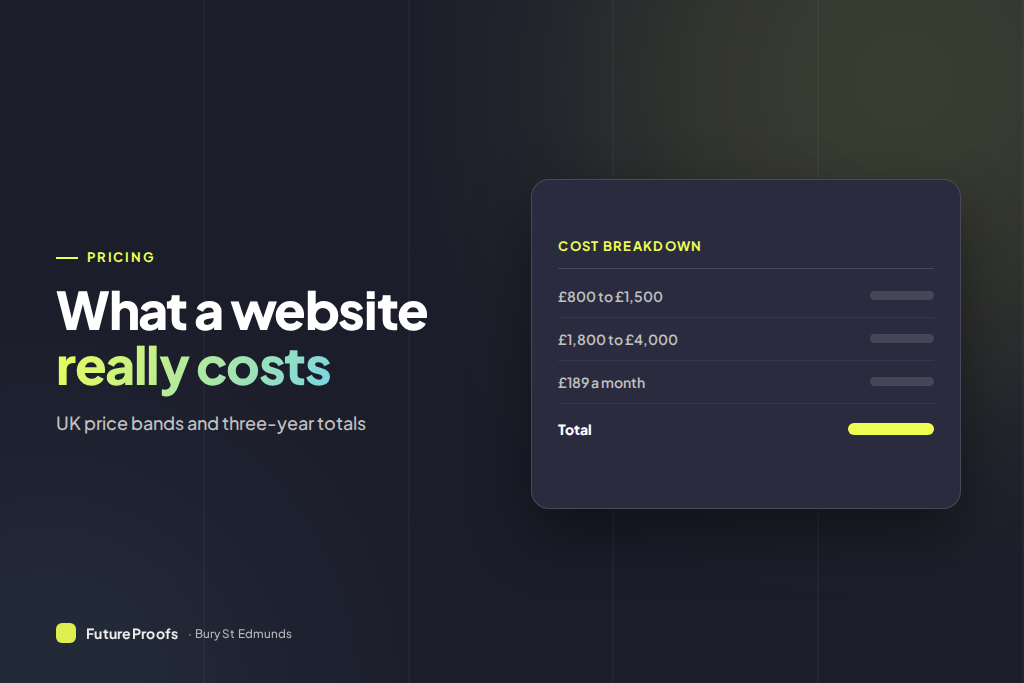
How much does a Webflow website cost? Here are the numbers before anything else. In the UK in 2026 it is £800 to £1,500 from a freelancer working off a template, £1,800 to £4,000 from a small studio building it properly, £4,995 upwards for custom ecommerce, and £8,000 to £20,000 or more from a city agency with a strategy team. On a monthly plan, which is how FutureProofs sells it, a site with hosting, edits and search work bundled in starts at £189 a month with nothing up front.
Those bands are wide because the word website covers a five page brochure and a hundred page programmatic build. What follows is what actually sits behind each number, what the whole thing costs once you add three years of running fees rather than just the build, and how to tell a fair quote from a bad one before you sign it.
There is also a section on where the £189 a month plan is the wrong answer, because a pricing article that concludes our own product suits everybody is an advert, and you can already spot those.
Key takeaways
- A custom Webflow build from a small UK studio typically costs £1,800 to £4,000, and £4,995 upwards for ecommerce.
- FutureProofs sells the website as a plan from £189 a month covering build, hosting, unlimited edits, monthly SEO and reporting, with no build fee.
- Webflow's own platform fees add roughly £420 a year on top of any build price, which most quotes leave out entirely.
- Over three years, a £3,500 build plus platform fees and upkeep lands near £5,700, against £6,804 for a £189 a month plan that includes the search work.
- Pay upfront if you have capital, want to own the site outright and already have someone doing the marketing. Take the plan if you do not.
How much does a Webflow website cost in the UK in 2026?
The market splits into five routes, and the price gaps between them are mostly about how much thinking happens before anyone opens the Designer.
| Route | Typical UK price | What that usually buys |
|---|
| Do it yourself | £0 to £400 a year | A template, your evenings, and no research into what people actually search for |
| Freelancer, template based | £800 to £1,500 | Five to eight pages, a tidied template, basic on-page SEO, a contact form |
| Small studio, custom build | £1,800 to £4,000 | Ten to fifteen pages, custom design, CMS for a blog, SEO foundations built in |
| Monthly website plan | £189 to £329 a month | Build, hosting, edits, ongoing search work and reporting, no upfront fee |
| Custom ecommerce or city agency | £4,995 to £20,000+ | Product catalogue and checkout, or strategy, research and a bespoke multi-location build |
A quote outside those bands is not automatically wrong, but it should come with an explanation. Under £800 for a custom build means somebody is working for less than minimum wage or handing you a template with your logo dropped in. Over £20,000 for a service business site in Suffolk means you are paying for an account manager, an office in London, and a research phase you may or may not need.
What you actually get at each price band
Under £1,500
A working, decent-looking site. What you are not paying for is the keyword research that decides which pages exist. That sounds like a technicality until you realise it is the whole game. A garage in Stowmarket with one page called Services will never rank for MOT Stowmarket, cambelt replacement Stowmarket or clutch repair Needham Market, because those pages do not exist. The build was fine. The structure was never decided. On our websites for Stowmarket businesses, the keyword research settles it before anything is designed.
£1,800 to £4,000
This is where a site stops being a brochure. You get a proper service page structure, a CMS you can publish into, schema markup, and someone who has thought about which towns and which services need their own page. It is the right band for most established local businesses buying outright, and it is where the money starts compounding rather than depreciating.
£4,995 and up for ecommerce
Selling online adds work that brochure sites do not have: product pages that convert, a checkout that behaves on a phone, payment and shipping integration, category structures that scale past fifty products, and SEO on every product page rather than just the homepage. FutureProofs builds custom Webflow ecommerce from £4,995, owned outright from launch. The AV Cleans build is a fair sense of what that includes, with a Royal Mail send-in flow and nationwide search work alongside the shop.
Above £8,000
Multi-location businesses, complex integrations, custom interactive work, programmatic builds across hundreds of pages. These are scoped case by case because the variables are too wide to package. Any agency quoting a flat price at this level without a scoping phase is guessing, and the difference will arrive later as a change request.
Where the £189 a month plan sits against those numbers
FutureProofs does not sell a build fee. The Starter plan is £189 a month and covers roughly 56 pages across six services and six towns, custom Webflow design, on-page SEO, hosting, speed work, a contact form, analytics, unlimited edits and a monthly ranking report. Business at £249 covers roughly 117 pages across nine services and ten towns, with full CMS setup, AI SEO schema markup, and Google Search Console and Business Profile configuration. Market Leader is £329 for businesses competing hard across several towns. There is no separate SEO retainer, because the search work is the point of the plan.
The differentiator worth understanding is the page count. Those are not one CMS template stamped out across a list of town names. Each page is individually written and individually designed, which is why clients rank in villages where larger competitors do not bother. That is also why the plans cost what they do: the work is real writing and real design, repeated. Full detail sits on the website plans page and the numbers are published on the pricing page rather than held back for a call.
Branding is priced separately because not everybody needs it. Brand Builder is £795 one-off, Brand Partner £495 a month, and if your logo is fine and your colours work you should skip both. There is more on what each covers on the brand and design page.
The three-year total, which is the number that actually matters
A build fee is a down payment on a website, not the cost of one. Compare like for like over thirty six months and the picture changes. This assumes a £3,500 custom build, Webflow's own platform fees at current rates, and modest upkeep.
| Over three years | Bought outright, no ongoing work | Bought outright plus a £400 a month SEO retainer | Starter plan at £189 a month |
|---|
| Build fee | £3,500 | £3,500 | £0 |
| Webflow platform fees | £1,260 | £1,260 | Included |
| Edits and upkeep | £900 | £900 | Included |
| Search work | £0 | £14,400 | Included |
| Three-year total | £5,660 | £20,060 | £6,804 |
| Own it outright? | Yes | Yes | After a £250 transfer |
Read the first column and the third together, because that is the real comparison for most businesses. Buying outright and doing nothing afterwards is about a thousand pounds cheaper over three years, and it buys you a site that is slowly going stale. The middle column is what most agencies actually sell once the build is done, and it is the most expensive route by a distance.
The costs most quotes leave out
Ask any agency for a three-year total cost of ownership figure before you sign. The gap between that number and the headline build price is where the unpleasant surprises live.
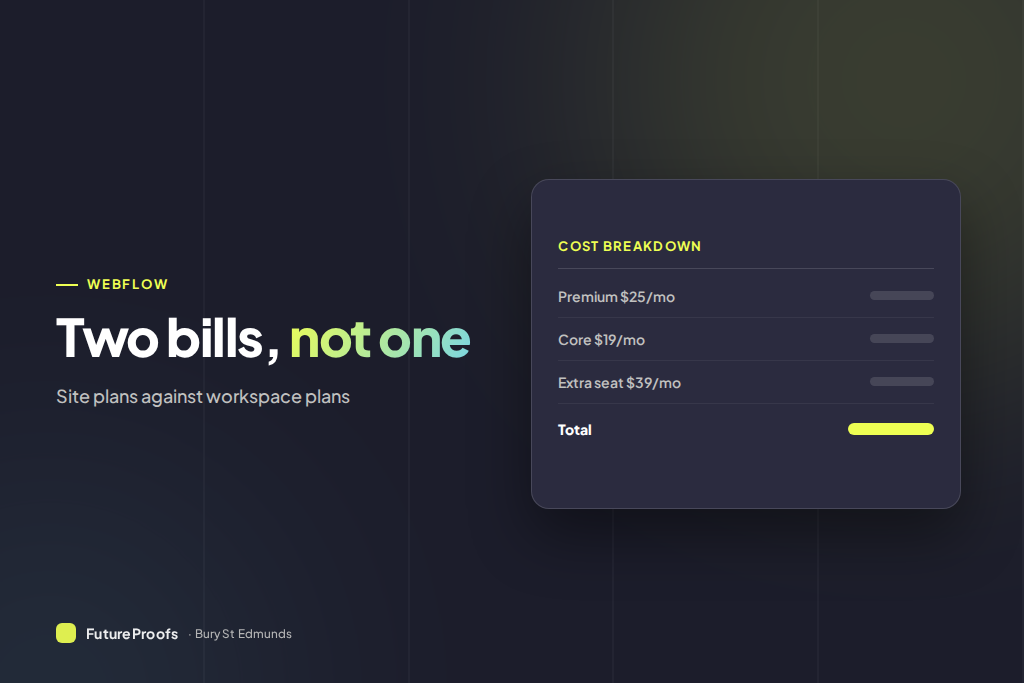
- Webflow's own platform fees. A Premium site plan is $25 a month billed annually, about £20, and the workspace plan you build in is billed separately from $19 a month. That is roughly £420 a year that sits outside almost every build quote. The breakdown of Webflow's own plan pricing covers what changed in May 2026 and which tier you actually need.
- Content. Copywriting and photography are frequently excluded, then quoted at £400 to £1,500 once the design needs filling. Ours are separate too, with shoots from £545. The point is that you should know which side of the line they fall on before you agree a price.
- Edits after launch. Hourly rates of £60 to £100 for a price change are common. Ask what a ten minute text edit costs in month seven.
- Forms, bookings and integrations. Third-party tools for booking, reviews or CRM sync carry their own monthly fees and rarely appear in the build quote.
- Search work. The build gets you a site. Ranking is a separate ongoing job, sold separately by most agencies, and it is the largest line in the middle column above.
When a monthly website plan is the wrong answer
Four situations where you should pay upfront and own it, and we will say so on the call.
- You already have someone doing the marketing. If you employ a marketer or have an agency running search, a plan that bundles SEO means paying twice for the same work. Buy the build.
- You have capital and no intention of publishing again. Some businesses genuinely need a credible site that sits there. A one-off build and a cheap platform fee is the cheaper route, and it is fine.
- You are selling the business inside two years. An asset on the balance sheet is worth more to a buyer than a subscription they have to assume.
- You need one page for one campaign. A single landing page for a Google Ads push does not need a website plan wrapped around it.
The plan earns its keep when nobody in the business has the website in their job description, when you want the search work happening whether or not you remember to ask, and when a predictable monthly number is easier to sign off than a four thousand pound invoice in January.
How to tell a fair quote from a bad one
Five questions, and you can ask all of them in one email.
- How many pages, and which ones? A quote that says website without a page list is not a quote. The list tells you whether anyone did the research.
- What is the three-year total including platform fees? If they cannot answer in a sentence, they have not thought about your budget.
- Who owns it, and what happens if we part company? Get the answer in writing before you pay anything.
- What does a change cost in month nine? This is the one that separates a partner from a project shop.
- Is the search work included or extra? Both answers are legitimate. Not being told is not.
If you are still weighing the platform itself rather than the price, the honest comparison of Webflow and WordPress covers the maintenance and lock-in trade-offs that decide the three-year figure.
Frequently asked questions
How much does a Webflow website cost in the UK?
Between £800 and £4,000 for most small business brochure sites, £4,995 upwards for custom ecommerce, and £8,000 or more for multi-location and programmatic builds. On a monthly plan the equivalent is £189 to £329 a month with no build fee. Webflow's own platform fees of roughly £420 a year sit on top of any build price.
Is a monthly website plan cheaper than paying upfront?
Not over three years if you compare a plan against a build alone, but it usually is once ongoing search work is counted. A £3,500 build plus platform fees and upkeep comes to about £5,660 over three years with no marketing attached. The same period on a £189 a month plan is £6,804 with the search work, hosting and edits included.
Does the quote include Webflow's own fees?
Usually not, and you should ask. Webflow bills a site plan per website and a workspace plan for the account it is built in, adding roughly £420 a year at current rates. On a FutureProofs plan those fees sit inside the monthly number, so there is no separate platform invoice to diary or renew.
Why do web design quotes vary so much for the same brief?
Because the brief is almost never the same, even when the words are. The difference between £900 and £3,500 is usually keyword research, page count and copywriting, not design skill. Ask each agency for the page list they are proposing and the variation stops looking mysterious very quickly.
What happens if I want to leave a monthly plan?
The plan runs on a twelve month minimum term and then rolls monthly. If you stop once the term is up, we move the site into your own Webflow account for a one-off £250 so it is yours outright. You then take on Webflow's site and workspace fees directly, which is the roughly £420 a year that was sitting inside the plan.
How long does a Webflow website take to build?
About a week for a Starter build from the day your content arrives, longer for a Business build because of the extra services and towns, and six to eight weeks for ecommerce because of the product catalogue and payment setup. The build is rarely the delay. How fast copy, photos and product data come back from your side is.
What to do before you sign anything
Work out what an enquiry is worth to you. Not revenue, gross profit on an average job. A groundworker in Haverhill clearing £900 a job needs the site to produce roughly four extra enquiries a year to justify £189 a month. A beauty clinic on a £60 treatment needs a lot more, which is why the answer to what you should spend depends on your margins rather than on an industry average.
Then decide honestly whether anyone will keep the site alive after launch. That single answer, more than the platform or the price band, decides which of the three columns in the table above you belong in. Everything else is detail.
If you want a straight number for your business rather than a range, send us your current site and the services and towns you want to cover, and we will tell you which plan fits. You can send a brief without booking a call.