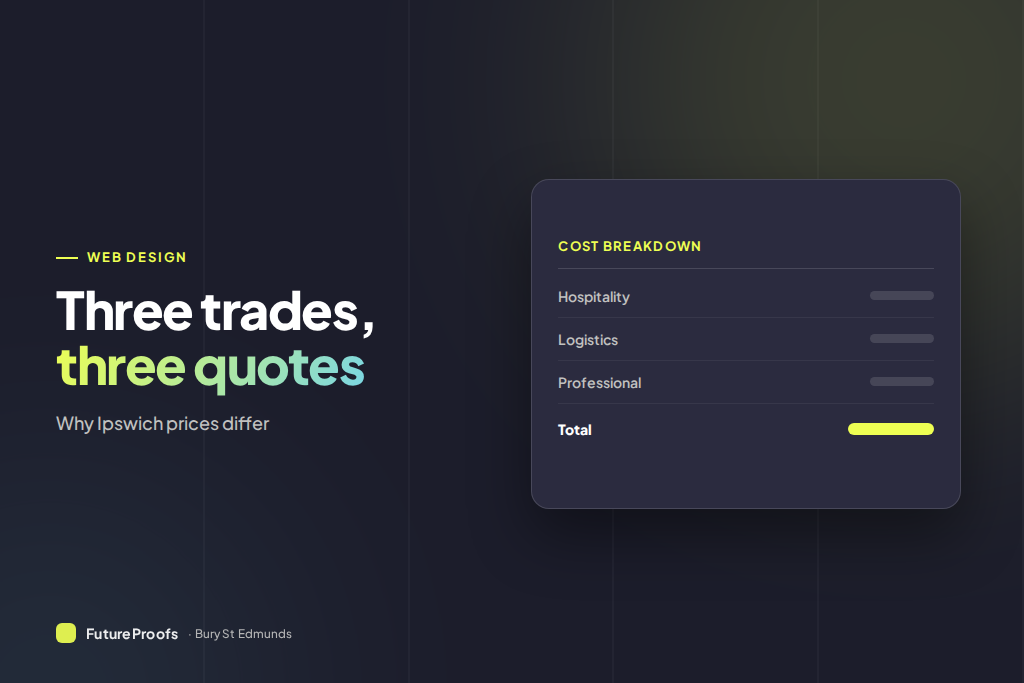
An Ipswich restaurant, a haulage firm running out to the port and a two partner accountancy practice all ask the same question in the same week. What does a website cost. All three are hiring a web designer in Ipswich, all three get quotes ranging from £400 to £9,000, and every one of them assumes the other two are being ripped off.
None of them is. They are buying three different machines. The restaurant needs a site that survives a Friday afternoon on a phone with one bar of signal. The haulier needs one that makes a transport manager confident enough to send a rate enquiry. The accountant needs one that answers a question about tax before a stranger will hand over their surname. Same word, three specifications, and that is why the quotes look confusing rather than dishonest.
This post works through what a website has to do for the three business types Ipswich actually has most of, what separates a good build from a cheap one in each case, and how to tell which one you are being sold.
Key takeaways
- Ipswich web design quotes vary because a restaurant, a haulier and an accountant need three different websites, not three price points for one.
- A hospitality site is judged on the menu, the booking and the opening hours, in that order, on a phone.
- A logistics site is judged by a buyer comparing carriers, so certifications, fleet detail and a fast quote route matter more than photography.
- A professional services site sells trust, so named people, real credentials and specific case detail earn more than a hero animation.
- FutureProofs website plans start at £189 a month with the Webflow build, hosting, unlimited edits and monthly SEO included.
Why two Ipswich businesses get quotes £5,000 apart
The gap is almost never craftsmanship. It is scope, and scope follows the job the site has to do.
A four page site for a sole trader is genuinely a small piece of work. A site that has to hold thirty service pages, a bookable diary, a quote form that routes to the right person and a set of location pages for every village between Kesgrave and Felixstowe is not the same job with more pages, it is a different project with different risks. When one quote is £400 and another is £9,000, the useful question is not who is honest. It is what each of them thinks you are trying to achieve.
So decide that first, before you read another proposal. Write one sentence describing the single action you want a stranger to take. Book a table. Request a rate. Ring the office. Everything in the quote either serves that sentence or is decoration you are paying for.
What a Waterfront restaurant or bar needs from a website
Ipswich hospitality has changed shape over fifteen years. The Waterfront went from working docks to a strip of restaurants and bars, the town centre trade shifted around it, and the competition for a Saturday booking is now decided almost entirely on a phone, in about ninety seconds, usually by somebody who has already opened three tabs.
The menu is the website
The single most common failure we see in Suffolk hospitality is a menu as a PDF. On a phone that means a download, a pinch, a zoom and a scroll sideways, and a meaningful share of people give up at the pinch. Worse, a PDF is close to invisible to search, so nobody ever finds you by searching for the thing you are actually known for. Put the menu on the page as text. It is not a design compromise, it is the most valuable page you own.
Booking, hours and the Christmas problem
The booking route needs to be one tap from wherever a person lands, not buried behind a contact page. Opening hours need to be correct on the site and on your Google Business Profile at the same time, because the two disagreeing is the fastest way to have somebody arrive at a locked door and leave a one star review about it. And every December, the business that has published its festive menu and its opening times by early November takes bookings from the business that has not. That is not a design job, it is an editing job, which is exactly why the ability to change your own site without paying by the hour matters more in hospitality than in any other sector. If you want the fuller picture, we set out the specifics on our page for pubs, restaurants and hotels.
What a Felixstowe facing logistics business needs
The other end of the A14 is the busiest container port in the country, and a good deal of Ipswich business exists because of it. Hauliers, freight forwarders, customs agents, warehousing, plant hire, marine services. The buyer here is not a consumer in a hurry. It is somebody comparing three carriers with a spreadsheet open, and they are looking for reasons to rule you out.
That changes the brief completely. Photography matters less. Proof matters more. A logistics site earns its keep when it makes the following easy to find without an email exchange.
- What you actually move. Container, palletised, temperature controlled, abnormal load, hazardous. Vague words lose you enquiries you never hear about.
- Where you run. Named ports, named corridors, and whether you do European work. Felixstowe, Harwich, Tilbury, London Gateway.
- Your fleet and your accreditations. Vehicle count, operator licence, FORS or similar, insurance levels. This is the section that gets read twice.
- A quote route that takes ninety seconds. Not a general contact form. A form that asks the four things you need to price a job.
- Who answers the phone. A named operations contact beats an info@ address every time in a trade that runs on relationships.
We built exactly this kind of site for a logistics firm the other side of the region, and the Nexus Transport Link build is a fair illustration of what the structure looks like when the buyer is professional rather than casual. The wider version sits on our logistics and haulage page.
What an Ipswich professional services firm needs
Accountants, solicitors, surveyors, IFAs and consultants around the Cornhill and out through the business parks are selling something a website cannot demonstrate. You cannot photograph competence. So the site has one job, which is to lower the risk of the first phone call.
That means named people with real photographs, not stock images of handshakes. It means saying what you specialise in rather than listing everything you are technically able to do, because a firm that says it handles agricultural partnerships and probate for Suffolk farming families will beat a firm that says full service every time, with the exact client it wants. It means publishing something about fees, even a range, even a starting point, because refusing to say anything about money reads as expensive rather than mysterious.
And it means answering the awkward questions in public. What happens if I switch mid year. Do you handle the Making Tax Digital filing or do I. How quickly do you reply. Those pages do double duty now, because they are also the pages an AI assistant lifts from when somebody asks it to recommend an accountant in Ipswich. Our professional services page covers how that is structured.
What separates a good build from a cheap one
Cheap is not the same as bad. A cheap build is a bad deal only when it cannot do the job the sector requires. Here is where it usually breaks, by trade.
| Ipswich sector | What the visitor is really checking | Where a cheap build loses the job |
|---|
| Waterfront hospitality | Menu, booking, tonight's opening hours | PDF menus, stale hours, booking three taps deep |
| Port and logistics | Accreditations, fleet, coverage, a fast quote route | One generic contact form and no proof of capability |
| Professional services | Who you are, what you specialise in, what it costs | Stock photography, no named people, no fees mentioned |
| Trades and home services | Areas covered, response time, evidence of past work | One page listing every village with no real content |
Notice that none of those failures are aesthetic. Every one of them is a decision somebody made about scope, usually to hit a price. That is fine when it is stated. It is a problem when the quote says website and lets you assume the rest.
Is a monthly website plan worth it?
Sometimes not, and it is worth saying so.
If you have a stable business, a site you rarely change, customers who already know your name and no ambition to rank for anything new, a one off build and cheap hosting is the sensible purchase. Paying monthly for a site nobody touches is paying for a service you have chosen not to use.
The plan earns its money in the opposite case. You want to be found for things you are not currently found for, the site needs to change often, and you have no interest in learning a page builder. At £189 a month the FutureProofs Starter plan carries the Webflow build, hosting, SSL, unlimited edits and the monthly search work and reporting in one figure, which means adding a service page in November costs you an email rather than a decision. Business is £249 and Market Leader £329, all published as plain figures so you can do the arithmetic against a build quote yourself.
The honest comparison is not month one. It is month twenty. Count how many changes you would want to make in that time, price them at a typical hourly rate, add hosting and whatever search work you would have commissioned, and see which column wins for your business rather than in general.
What to ask a web designer in Ipswich before you sign
Five questions, in this order. They take about ten minutes and they save arguments later.
- What is the one action this site is designed to produce? If the answer is engagement or presence, keep looking.
- Who writes the copy, and who writes the next ten pages? Copy is the part that quietly becomes your homework.
- Is the search work included or sold separately, and at what monthly figure? Get both halves in one document.
- Who owns the domain, the hosting account and the design file? The answer should be you, in writing, before you pay a deposit.
- Can I edit it myself, and what does a change cost if I cannot? Hospitality especially: an uneditable site is a stale site by February.
Then do one thing that costs nothing. Open two of their live client sites on your phone, on mobile data, and count the seconds before you can read anything. That single test has ended more of our own sales conversations honestly than any slide ever has.
Frequently asked questions
How much does a website cost in Ipswich?
Most Ipswich small business websites fall between £600 for a one off freelance build and £9,000 for a larger agency project, with monthly plans running from roughly £150 to £350. FutureProofs plans start at £189 a month including the build, hosting, unlimited edits and monthly SEO. The range reflects genuinely different scopes rather than one product priced differently.
How long does an Ipswich business website take to build?
Two to four weeks for a focused site of five to ten pages, and four to eight weeks for a larger build with location pages, a booking system or ecommerce. The timeline usually turns on how fast you supply photographs, menus, accreditations and feedback rather than on design time. Ask for stages with your input dates written in.
Do I need a web designer based in Ipswich?
No. Nothing about building or ranking a website requires the designer to be in the same town, and the work happens in a browser regardless. What matters is whether they understand your trade and the way local customers search. We work with Ipswich businesses from Bury St Edmunds, roughly forty minutes up the A14, and travel when a project genuinely needs a face in the room.
Is Webflow a good choice for a small Ipswich business?
For most it is, because hosting, security and updates are handled inside the platform rather than through a plugin maintenance contract, and the editing side is simple enough for a manager to change a menu without breaking the layout. WordPress still suits large editorial sites and complex membership systems. Judge it on who has to edit the site on a Tuesday afternoon.
What is the fastest fix if my current site is not bringing in work?
Check three things before spending anything: how fast it loads on a phone on mobile data, whether the single action you want is visible without scrolling, and whether your opening hours and contact details match your Google Business Profile exactly. Those three cost nothing to correct and they fix more lost enquiries than a redesign usually does.
Will a new website rank in Ipswich straight away?
No. A new site typically starts appearing for longer, more specific searches within four to eight weeks, and takes several months to compete for the busiest local terms. Ranking follows structure, genuinely written pages for each service and place you cover, and an active Google Business Profile with recent reviews. Anyone promising page one in a fortnight is describing an advert.
Where to start if your Ipswich site is not bringing work in
Start with the sentence. One action, one visitor, written down. Then open your own site on your phone outside the office and see how many taps stand between a stranger and that action. In hospitality it is usually the menu. In logistics it is usually the quote form. In professional services it is usually the fact that nobody can tell who works there.
Fix what you can fix yourself this week, because a fair amount of it is content rather than code. Correct the hours. Turn the PDF into a page. Put a real name and a direct number where the info@ address is. Then judge whether what is left is a redesign or a rebuild, and get two quotes for it rather than one.
When you want the version with the search work attached, the scope and the monthly numbers sit on our Ipswich web design page, the local ranking side is covered on the Ipswich SEO page, and the village level coverage from Kesgrave out to Felixstowe is on the Ipswich areas page. If you would rather just see the numbers first, they are all on the pricing page.