A customer opens an assistant, says she needs a groomer near Bury St Edmunds who can take a nervous cocker spaniel on a Saturday, and asks it to sort it out. She never opens a browser. She never sees your homepage, your photographs or the bit about being family run since 2011. Something machine-shaped reads whatever it can find about you and decides in a couple of seconds whether you make the shortlist.
That is the question behind AI agents and your website, and it is a different question from ranking. Ranking asks whether a person can find you. This asks whether software can use you. A site can be perfectly good at the first and useless at the second, and most small business sites in Suffolk currently are.
Here is what this post settles: what has actually shipped versus what was announced, the specific places an agent gets stuck on an ordinary small business site, and the short list of fixes worth doing this quarter. It is early days and I will say so plainly rather than pretend the sky is falling.
Key takeaways
- Google's agentic booking, including asking Google to ring businesses on your behalf for home repair, beauty and pet care, launched in the United States over summer 2026 and has not reached the UK.
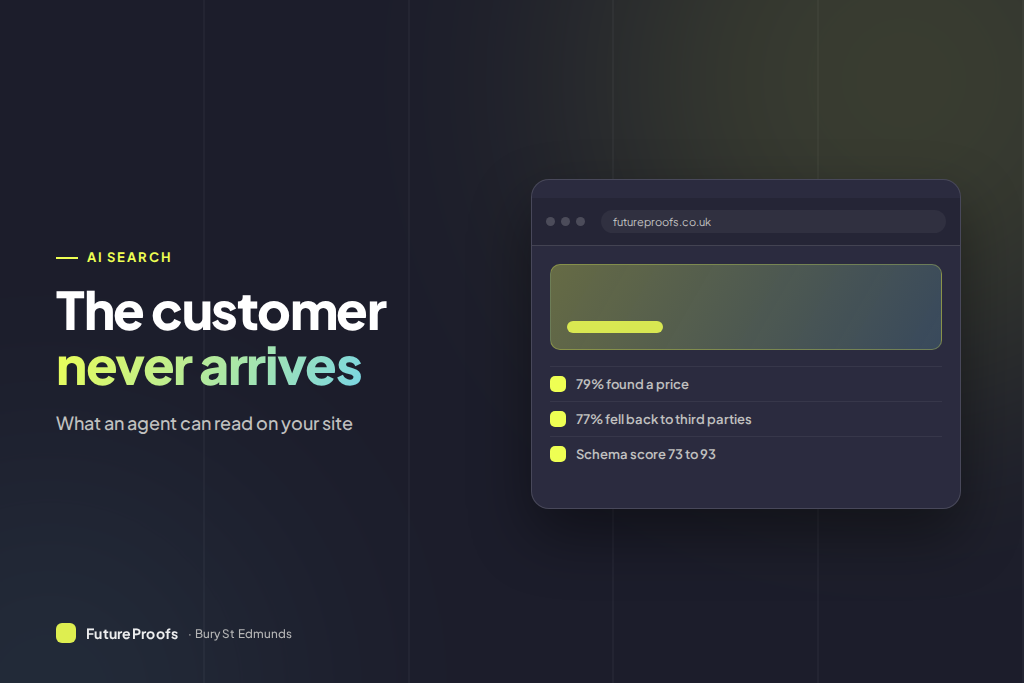
- In a July 2026 test of 100 sites, agents retrieved a price directly from the business only 79 per cent of the time, and fell back to third-party sources on 77 per cent of runs where the page failed to load.
- Adding Product and Offer schema with a currency lifted one machine-readability score from 73 to 93, making it the cheapest single fix available.
- Prices, hours and phone numbers rendered by JavaScript or trapped in an image are invisible to most agent fetches, however good they look to a human.
- A UK audit of 728 AI-recommended businesses in August 2026 could not verify 5.2 per cent of them as actively trading, so being checkable is now part of being recommended.
What AI agents and your website have to do with each other
An agent is software acting on a person's instruction rather than answering their question. It reads, compares, fills forms, sometimes pays, and increasingly makes phone calls. The customer's attention never lands on your site at all, which removes every advantage that good design used to give you and leaves only what the machine can extract.
That extraction is brutally literal. It does not infer that you are probably open on Saturdays because your competitors are. It does not guess that a fitted bathroom starts around four thousand pounds because that is the going rate in Suffolk. If the fact is not on the page in text it can read, the fact does not exist, and the agent moves to the business where it does.
What Google actually announced, and what has shipped
At I/O in May 2026 Google extended agentic booking from restaurants and tickets to local experiences and services, and said that for selected categories including home repair, beauty and pet care you can ask Google to call businesses on your behalf. Information agents, which watch the web in the background and report back when something matches, went to AI Pro and Ultra subscribers, and were extended across all AI Mode languages in June 2026.
Now the honest part. The calling and booking features rolled out in the United States over the summer. They are not live in the UK, and nobody at Google has published a British date. The background on how these answers are assembled sits in the explainer on Google AI Mode and query fan-out, which is the surface most of this will arrive through.
The commerce plumbing is further along than the consumer experience, and it tells you where this is going. Google and Shopify launched the Universal Commerce Protocol in January 2026. Google handed its Agent Payments Protocol to the FIDO Alliance in April. OpenAI and Stripe shipped the Agentic Commerce Protocol, then quietly shut down native Instant Checkout in March 2026 after adoption disappointed. Several serious companies are building the rails. Nobody has proved the customer wants to travel on them yet.
Which is why the sane posture is preparation, not panic. Everything below improves your site for humans and search today, and happens to make you legible to an agent tomorrow.
Where an agent gets stuck on a small business site
In July 2026 Kevin Indig and David Kaufman ran agents against 100 company websites to see whether they could retrieve basic commercial facts. Agents got a price straight from the business only 79 per cent of the time. When a page failed to load at all, which happened on 7 per cent of runs, reliance on third-party sources jumped from 17 per cent to 77 per cent. In plain terms: when your site fails, the machine describes your business using a directory listing or a competitor's comparison page.
The failure points repeat, and none of them are exotic.
- Prices that appear after the page loads. Anything built by a script, a calculator or a toggle is frequently missed.
- Facts baked into images. A price list saved as a JPEG, a phone number inside a header graphic, opening hours in a Facebook-style poster.
- Booking behind a third-party widget. If availability lives inside an embedded iframe, an agent sees a blank rectangle where your Saturday slots should be.
- Contact only by form. No phone number, no email, no address in text, so there is nothing for the agent to act on.
- Blocked crawlers. A robots file that quietly bars GPTBot, ClaudeBot or PerplexityBot removes you from the pool entirely.
- PDF menus and brochures. Popular with hospitality across Suffolk, and consistently the worst-read format on any site.
Read that list again and notice something. Every item on it also annoys a human on a phone in a car park. Machine-readable and considerate are the same standard.
What machine-readable actually means for a plumber or a clinic
Four categories of fact carry almost all the weight, because they are what an agent must confirm before it can act.
| What the agent needs | How most sites publish it | What actually works |
|---|
| Opening hours | An image, or a footer that contradicts the Google profile | Text on the page plus LocalBusiness schema, matching the profile exactly |
| Prices | Please call for a quote, or a calculator widget | A real from-price in text, with Offer schema and the currency stated |
| Availability | An embedded booking iframe | Text stating typical lead time and the days you work, alongside the widget |
| Contact and area | A form, and towns listed only in a map graphic | Phone, email and named towns as selectable text on every service page |
Schema is the cheapest fix on the list
In that same July 2026 test, adding Product and Offer markup with a currency raised a site's machine-readability score from 73 to 93. It is a block of structured data sitting in the code that names what you are, where you work, what you charge and how people rate you. It takes an afternoon. If you want the detail, the guide to schema markup and what each type does covers which ones matter.
From-prices beat call for a quote
The objection is always the same: every job is different, so a price would mislead. Fine. Publish a from-price and a worked example instead. Boiler service from £95, most jobs done inside two hours. Composite front door fitted from £1,400, usually ten working days from survey. That sentence answers an agent, a customer and a competitor's nosy quantity surveyor, and only one of those three matters.
Keep a text version of everything a widget renders
You do not have to rip out your booking system. Put a short plain paragraph next to it saying which days you take appointments, how far ahead you are booked and what to do for an emergency. The widget serves the human who clicks. The paragraph serves everything else, including the search engine that never could read the widget either.
Be verifiable, not just visible
A UK audit in late August 2026 checked 728 businesses that AI assistants had recommended and could not confirm 5.2 per cent of them were actively trading. Assistants are already recommending ghosts. Consistent name, address and phone across your site, your Google profile and your trade body listing is not admin, it is the evidence that you are real.
Do you need to rebuild your website for this?
Almost certainly not, and anyone telling you otherwise this year is selling something. If your site loads fast, renders its content on the server and you can edit a page yourself, the work here is a content and markup job measured in days.
The rebuild conversation is only honest when the bones are wrong: a site that renders everything through JavaScript, one you cannot edit without ringing a developer, or one where the last three years of prices live in a PDF because nobody could change the page. That is not an AI problem. That was already costing you enquiries. Our view on what a build should include as standard sits on the website plans page, and the numbers are on the pricing page.
What to do this quarter
Sequenced by effort, cheapest first.
- View your key pages with images disabled. Anything that disappears is invisible to an agent. Fix those first.
- Put a from-price on your top three services in ordinary text, with a sentence explaining what moves it.
- State hours, lead time and service area in words on every service page, then make the Google Business Profile match exactly.
- Add LocalBusiness, Service and Offer schema across the pages that carry those facts.
- Check your robots file for blanket blocks on AI crawlers you did not intend.
- Decide who answers a lead that arrives with no context, because an agent-driven enquiry has no browsing history behind it.
That last one is the part people skip. If an assistant hands a customer to your contact form at ten past nine on a Sunday, someone has to reply before she asks it to try the next firm on the list. Getting every enquiry into one pipeline is what the CRM and automation setup is for, and chasing them within minutes rather than days is the other half of it. For the wider sequence across AI search, work through the AI search readiness checklist.
Frequently asked questions
Can AI agents book appointments on my website right now?
In the UK, not yet through Google. Agentic booking for local services, including Google ringing businesses on a customer's behalf, launched in the United States over summer 2026 with no announced British date. General purpose assistants can already fill in web forms, so a simple form-based enquiry is more reachable today than an embedded third-party calendar.
How do I make my website readable by AI agents?
Publish the commercial facts as plain text and mark them up with schema. Prices, opening hours, service areas, lead times and a phone number should be selectable text on the page, not images or script-generated content. Add LocalBusiness, Service and Offer structured data, and make sure your Google Business Profile says the same things.
Will AI agents replace Google search?
Not soon, and probably not entirely. OpenAI shut down its native Instant Checkout in March 2026 after weak adoption, which is a useful reality check on how fast people change buying habits. The safer read is that agents become another route to the same shortlist, sitting alongside search rather than replacing it.
Does agentic search mean SEO no longer matters?
The opposite. Agents read the same crawled web that search ranks, and a UK study in August 2026 found a business's own website cited in 90 per cent of AI answers about local firms. Fast pages, clean structure and honest specifics still decide everything. What changed is that vague copy now fails silently instead of ranking badly. That holds as much for SEO in Norwich as for a village business outside Bury St Edmunds.
Should I block AI crawlers from my site?
For almost every small business, no. Blocking removes you from the pool an agent draws on, and the businesses it recommends instead will be your competitors. Blocking makes sense for publishers whose income depends on advertising against their own pages. It rarely makes sense for anyone selling a service in Suffolk.
What if I have no online booking system at all?
You are not badly placed. A phone number and an email address in plain text, with clear hours and a stated response time, are more usable to an agent than a sophisticated calendar locked inside an iframe. Add the booking system when your customers ask for it, not because software might want it.
The quiet version of this you can start on Monday
Nothing about this requires believing that agents will take over. It requires accepting that an increasing share of the machines describing your business to a customer will never see your design, only your facts. Publish the facts.
The businesses that will be fine are the ones that already say what they charge, where they work and when they can come. Those are the same businesses that convert well on a phone screen and rank properly in a local search, which is a reasonable clue that this is not a new discipline so much as an old one with a stricter examiner.
Spend an hour reading your own service pages as if you were a machine that cannot see. If you would rather have someone do that for you and hand you the list, send us the address of your site and we will tell you what is missing.