Somebody has emailed you about answer engine optimisation. Or you have read a post announcing that SEO is finished and AEO is what replaced it, and you are trying to work out whether that is a genuine change in how customers find you or a consultant renaming the same work at twice the price.
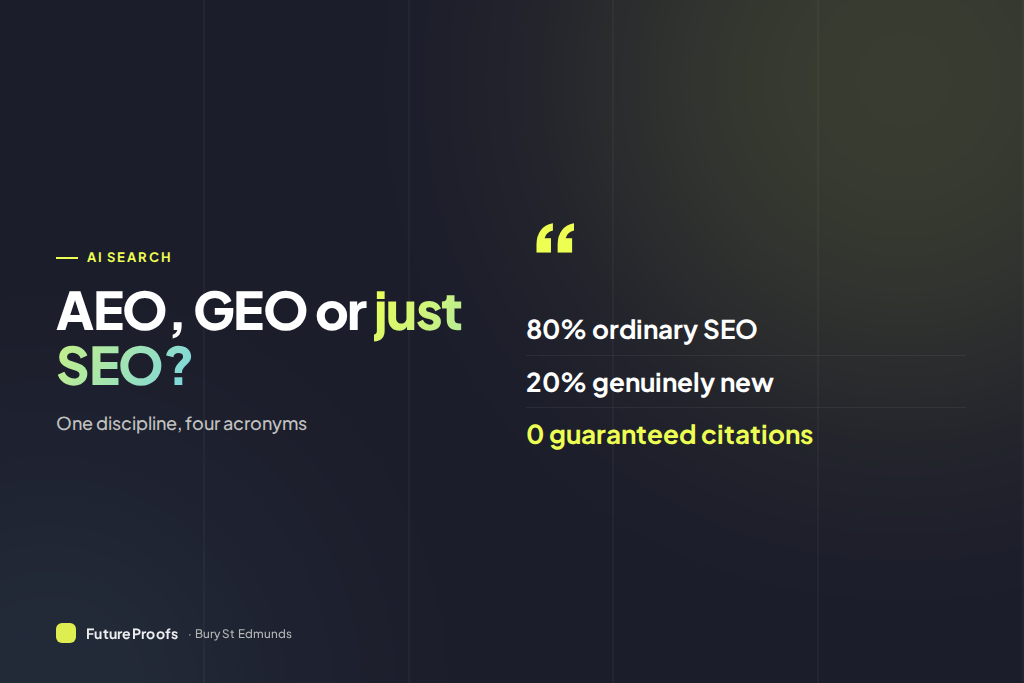
Fair question, and here is the short answer. AEO is the work of making your business easy for an AI assistant to understand, trust and name when someone asks it something you could answer. The shift in customer behaviour behind it is real. The idea that it is a new profession is not. Roughly four fifths of it is competent search work you should have been doing anyway, and the remaining fifth is genuinely different and worth learning.
This post settles the terminology, sets out exactly what changes between optimising for a list of links and optimising to be quoted, and shows the same page written both ways so you can judge the difference yourself. The step by step tactics for ChatGPT, and the question of whether to pay a vendor for citations, have their own posts and are linked further down.
Key takeaways
- Answer engine optimisation is the practice of making a business legible and quotable to AI assistants such as ChatGPT, Google AI Overviews, Gemini, Perplexity and Claude.
- AEO, GEO, LLMO and AI SEO describe the same discipline; the acronym is vendor branding rather than a difference in method.
- About 80 percent of the work is ordinary SEO done properly: consistent business details, fast pages, structured data and genuine reviews.
- The genuinely new part is writing so that a single paragraph can be lifted out of its page and still be true, complete and clearly attributable to you.
- Nobody can guarantee a citation in an AI answer, and Google confirmed in May 2026 that its spam policies apply in full to its generative features.
What answer engine optimisation actually is
AEO is what you do to a business so that an AI assistant can describe it accurately and is willing to put its name in an answer. That is the whole definition. The engines in question are Google AI Overviews and AI Mode, ChatGPT, Gemini, Perplexity, Claude and whatever arrives next, and they all do the same thing: read the open web, build a picture of who exists and what they do, then write a short answer naming two or three of them.
The important difference from ordinary search is what the engine is ranking. Google's blue links rank pages. An answer engine assembles an understanding of an entity, meaning your business as a thing that exists in the world with an address, a set of services, a price range and a reputation, and then decides whether it is confident enough to recommend you. You are not competing for position four any more. You are competing to be one of the three names in a paragraph, and if you are not in that paragraph there is no position five to fall back on.
That is the strategic change. A butcher ranking seventh still picked up the odd click. A butcher who is not named in an AI answer gets nothing from that query at all.
AEO, GEO or LLMO: does the acronym matter?
Not much, and anyone who tells you otherwise is selling something. Three or four labels are competing for the same work, and the vendor ecosystem is arguing about which one wins. Here is what each of them means in practice.
AEO, the original term
The oldest of the terms and the broadest. It covers any surface that answers a question directly rather than listing links, which historically included featured snippets and voice assistants long before ChatGPT existed. It is the term with the clearest plain English meaning, which is why we use it.
GEO, generative engine optimisation
Narrower and more recent. It refers specifically to generative systems, the ones that write a fresh sentence rather than lifting an existing one. In day to day work the tasks are the same as AEO. The distinction matters to academics and to software vendors who need a category name for their dashboard. It does not change what you would do to your website on Monday.
LLMO, AI SEO and the rest
LLM optimisation and AI SEO are the same idea again, badged for whoever is buying. If a proposal uses one of these terms as though it describes a separate service with a separate fee, that is a pricing decision rather than a technical one. Ask what the actual tasks are. If the answer is schema, content structure, listings and reviews, you are being quoted for SEO.
One small point on spelling that is not trivial for a British business. Most published guidance on this subject is American, so it says optimization. Writing answer engine optimisation with the British spelling is both correct for a UK audience and a genuinely less crowded phrase to be found for, which is a rare thing in search these days.
How answer engine optimisation differs from SEO
The two overlap heavily, but they are not identical, and the differences are easiest to see side by side.
| Question | Traditional SEO | AEO |
|---|
| What is competing? | A page, against other pages | Your business as an entity, against other businesses |
| What does a win look like? | A ranking position and a click | Your name inside the answer, with or without a click |
| What gets rewarded? | Relevance, links, page experience | Clarity, specificity, agreement between sources |
| How do you measure it? | Rankings, clicks, impressions | Impressions in AI surfaces, plus manual prompt checks |
| Where does the visitor land? | On the page that ranked | Often on your homepage, or on the phone, or nowhere |
| How fast is the feedback? | Days to weeks | Weeks to months, and inconsistent between engines |
The last row is the one that catches people out. Ask the same question of ChatGPT twice in a week and you can get two different sets of businesses. That is not a fault in your website, it is how the systems work, and it is why any promise of a fixed number of citations per month should make you close the email.
The eighty percent that is ordinary SEO done properly
Most of the AEO checklist is not new. It is the unglamorous work that a lot of small business websites never had done in the first place, which is why it now looks like a fresh discipline.
- Consistent business details. Name, address, phone number and opening hours identical on your site, your Google Business Profile and every directory. Contradictions make an engine hedge, and a hedging engine names someone else.
- A complete Google Business Profile. Every category, every service, real photographs, current hours. It is the single most influential source for local queries in every assistant we have tested.
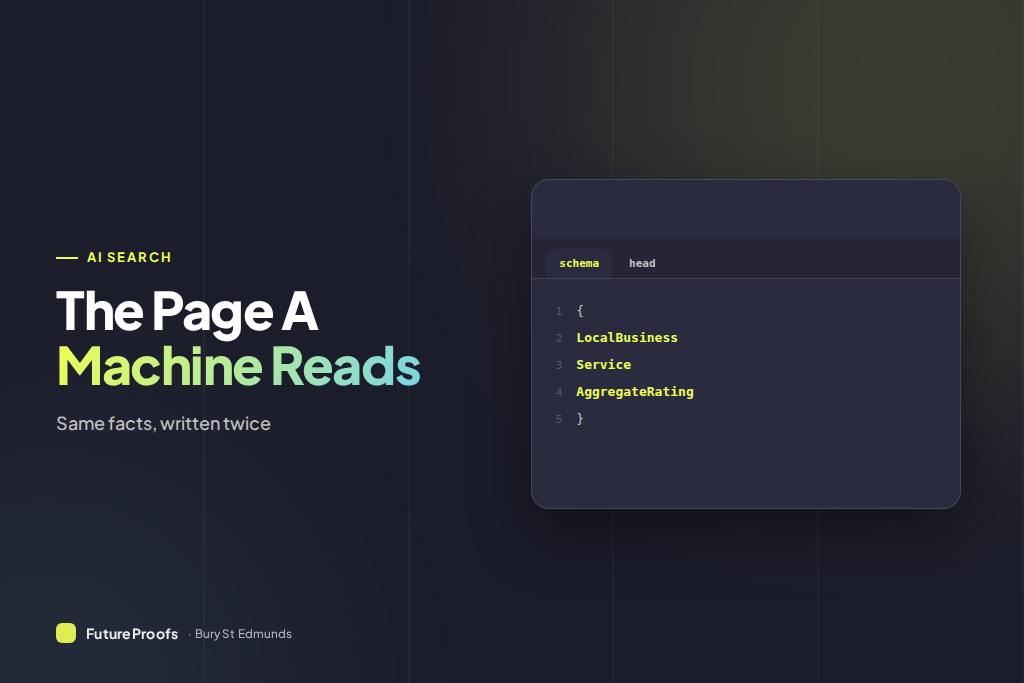
- Structured data. Schema markup states your hours, services, location and reviews in a format a machine reads without inferring anything from your layout. Our post on why a website needs schema markup covers the specifics.
- Real reviews with real detail. Twenty reviews that name the actual job are worth more than eighty that say "great service", because the wording of a review becomes the wording an assistant uses to describe you.
- Pages that load quickly on a phone. Slow pages get crawled less, which means less of your content is in the index the engines draw from.
- A page for each real thing you do, in each place you do it. An engine cannot recommend you for emergency callouts in Stowmarket if no page on your site says you do them.
None of that is exotic. All of it sits inside the ongoing search work in every FutureProofs plan rather than being sold as a separate AI retainer.
The twenty percent that is genuinely different
Two things change materially once you are writing for engines that quote rather than link.
Every paragraph has to survive being lifted out
An assistant does not read your page top to bottom and form an impression. It pulls a passage and repeats it. So a sentence that only makes sense because of the heading above it, or because the price was mentioned three paragraphs earlier, is useless to it. Each paragraph needs to name the business, the service, the place or the number it is talking about, inside itself.
The test is to read any paragraph on your website in isolation, with the rest of the page hidden. If a stranger could not tell what business it describes or what it costs, an assistant cannot either.
Agreement across sources beats volume of content
In traditional SEO, publishing more usually helped. Here, publishing more contradictory or vague material actively hurts, because the engine is trying to resolve who you are and every inconsistency lowers its confidence. Fixing an old directory entry with a former address is often worth more than writing three new blog posts.
The same page, written twice
Here is the difference in practice. Take a butcher near Bury St Edmunds selling dry aged beef, roughly the sort of business we worked with at The Barn Butchery. Same facts, two ways of writing them.
Version one, written for blue links
"We are proud to offer a wide range of quality meats to customers across Suffolk. Our experienced team is passionate about traditional butchery and we source only the finest local produce. Whether you are planning a special occasion or a family dinner, we have something for everyone. Get in touch to find out more about what we can do for you."
Sixty words that could describe any butcher in England. No place, no price, no product, no detail a machine could repeat. It might still rank, because links and domain history do a lot of work. It will never be quoted, because there is nothing in it to quote.
Version two, written to be quoted
"We dry age our beef on the bone for 28 days in a Himalayan salt chamber at the shop, four miles from Bury St Edmunds. A 28 day sirloin is £34 a kilo and a fore rib for six is around £58. Orders placed by Thursday are ready for collection on Saturday morning, and we deliver free within ten miles, which covers Thurston, Woolpit and Rougham."
Same length. It names a place, a process, a price, a timescale and a delivery area. Every sentence stands alone. If an assistant is asked where to buy dry aged beef near Bury St Edmunds, the second version has given it five separate facts it can repeat with attribution, and the first has given it nothing.
That is the whole craft, honestly. Not prompts, not tools, not a dashboard. Specificity written in complete sentences.
What AEO is not
It is not a service that can promise you placements. The engines assemble answers at the moment of the query from sources they judge useful right then, so there is no slot to buy and no supplier who can hold one for you. Google confirmed in May 2026 that its search spam policies apply in full to its generative features, which means manipulated or paid AI placements carry the same risk as bought backlinks. If a proposal on your desk prices citations per mention, our post on why buying AI citations is now treated as spam is the one to read before you reply.
It is also not a replacement for local search. If you serve one town, the map pack and your Google Business Profile still win more work than any AI surface, which is why search work across Suffolk and answer engine work are the same budget rather than two.
Frequently asked questions
What is answer engine optimisation?
Answer engine optimisation is the practice of making a business easy for AI assistants to understand, trust and name in their answers. It covers Google AI Overviews, ChatGPT, Gemini, Perplexity and Claude. In practice it combines consistent business information, structured data, genuine reviews and content written in self contained, specific paragraphs that can be quoted accurately.
Is AEO different from GEO?
In practical terms, no. AEO stands for answer engine optimisation and GEO for generative engine optimisation, and both describe the work of getting a business named in AI generated answers. GEO is slightly narrower in that it refers only to generative systems. The tasks are the same, so treat any price difference between them as marketing rather than method.
Does AEO replace SEO?
No. Around 80 percent of the work is standard SEO, so treating AEO as a replacement means paying twice for one job. Traditional search still delivers most enquiries for local businesses, particularly through the map pack. The sensible approach is one programme of search work with the AI specific parts, mainly content structure and entity consistency, built into it. We run SEO for Huntingdon businesses exactly that way, with the AI work inside the same plan.
How long does AEO take to work?
Expect three to six months before you see consistent change, with faster movement if your Google Business Profile and reviews are already strong. The foundations can be fixed in a few weeks, but the engines need to recrawl the web, notice that your sources now agree, and build enough confidence to name you. Results also arrive unevenly across different assistants.
Do I need schema markup for AEO?
You do not strictly need it, but it is one of the highest value things you can add, because it states your hours, services, location and reviews in a format machines read without guessing. Most small business websites still have none, so adding it is often a straightforward way to pull ahead locally. It is included as standard in every FutureProofs website plan.
How much does AEO cost in the UK?
For a small business it should not be a separate line item. At FutureProofs the schema, the content structure and the ongoing search work all sit inside a website plan from £189 a month rather than an additional AI retainer. Be wary of any quote that adds AEO on top of an existing SEO fee without adding new tasks to the scope.
Where to start this week
Do the boring half first. Open your Google Business Profile, your website footer and the three directories you are listed on, and make the name, address, phone number and hours identical across all of them. That single afternoon of tidying does more for your odds of being named than any amount of clever content, because it removes the contradictions that make an engine hedge.
Then take your three most important service pages and apply the isolation test to every paragraph. Where a paragraph does not name the service, the town, the price or the timescale it is describing, rewrite it so it does. You are not writing for a robot, you are writing the way a good tradesperson answers a question at the door: plainly, with the number in it.
After that, the two specific follow ons are worth your time. Read how to get cited by ChatGPT for the step by step version aimed at one assistant, and what Google AI Overviews mean for a small business for the surface most UK customers see first.
If you would rather this were simply handled alongside your website and search work, the plans and what is included in each are published in full.