You are parked up outside a job in Stowmarket with twenty minutes before the next one, and the thing nagging you is not that the phone is quiet. It is that the work coming in is the wrong work. Call-outs at nine at night for a hundred and forty quid. Somebody else fitting the bathrooms.
Good web design for plumbers is mostly about fixing that mix, because a plumbing business has two completely different customers wearing the same coat. One has water coming through a ceiling and will ring whoever answers. The other has been thinking about a new bathroom since February, will get three quotes, will look hard at photographs, and will take a fortnight to decide. They find you differently, they judge you differently, and they are worth very different amounts.
Most plumbers' sites are built entirely for the first customer and quietly lose the second. This is about building one site that wins both, what each type of page actually needs on it, and what to honestly expect from the thing in the first three months.
Key takeaways
- Emergency plumbing work is won on speed and proximity; planned work such as bathrooms and boiler replacement is won on photographs, proof and reassurance, and it pays considerably better.
- An emergency page needs a tappable phone number, the towns you cover in plain text and your real answering hours in the first screen. Almost nothing else on it matters.
- A bathroom or boiler page needs finished job photographs, a price range, your Gas Safe registration number and a named human being.
- A new plumbing website typically produces brand and long-tail enquiries in month one and town-plus-service rankings from around month three; anyone promising page one in six weeks is selling you something.
- FutureProofs builds plumbing websites from £189 a month with hosting, unlimited edits and monthly SEO in one figure.
The two jobs your website has to do, and why they pull in opposite directions
Most arguments about plumbers' websites go wrong because people talk about the customer as though there is one of them. There are two, and what pleases one actively annoys the other.
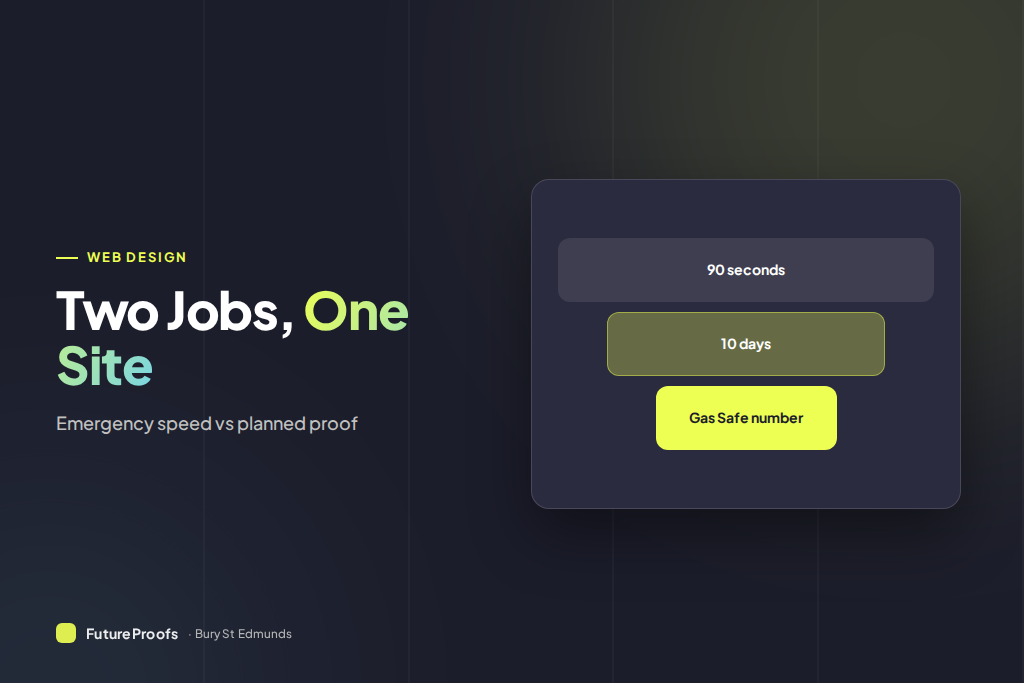
Emergency work is decided in about ninety seconds
A homeowner in Haverhill with a burst pipe is not reading your About page. They are on a phone, standing in water, and they will ring the first two or three numbers they can tap. What they need is a number, confirmation that you come to Haverhill, and a sense that somebody will pick up. Everything else is noise, and anything sitting between them and the number costs you the job. Clearing that path is the first thing we fix on websites for Haverhill trades.
The work has real value. It fills gaps, it builds review volume, and a good callout is how plenty of long relationships start. But it is unsociable, it is priced against people cheaper than you, and there is no loyalty in it. Nobody bookmarks the plumber who fixed the leak.
Planned work is decided over about ten days
A couple in Newmarket costing up a new bathroom behave nothing like that. They will find four plumbers across a fortnight, look at every photograph you have, work out whether your finishing is any good, check whether you have done a room like theirs, and worry quietly about whether you will disappear halfway through with their money.
This is where the margin is. A full bathroom, a boiler swap with new controls, a heating upgrade: jobs where the gap between winning and not winning is a year-defining number, and they are won on evidence. Photographs of finished rooms, a straight answer about money, and proof you are who you say you are. The site has to do both, which means it cannot be one page.
What an emergency page needs, and what to leave off it
Build it as its own page, not a section of the homepage, so it can rank for the searches that are typed in a panic. Then keep it brutally short:
- A tappable phone number, twice. Top of the screen and again at the bottom. Not an image of a number. Not a contact form.
- Your actual answering hours, written out. "Answered until 10pm seven days" beats "24/7 emergency service" if the second one is not true, and everybody in your trade knows it usually is not.
- The towns you genuinely cover, in text. Bury St Edmunds, Stowmarket, Haverhill, Newmarket, whichever they are. Not a map graphic, because a map graphic is invisible to a search engine.
- A one-line callout charge. Saying "£95 callout, first hour included" filters out the person who was never going to pay and reassures the person who was.
- What to do right now. Where the stopcock usually is in a Victorian terrace, how to isolate the boiler. Genuinely useful, takes thirty seconds to write, and it is the sort of thing an AI assistant will happily quote back with your name attached.
What to leave off: your history, your values, a slider, a chat widget that covers the phone number on a small screen, and a form with more than three fields. Every one of those is a reason for a wet homeowner to go back to the search results.
Answering hours are a promise, not decoration
If the page says 24/7 and the phone goes to voicemail at eleven, you have not won a job, you have bought a bad review. Either commit to it, put a diverted number on it, or write the hours you actually keep. Writing the truth converts better than you expect, because homeowners have been let down by "24/7" enough times to have stopped believing it.
What a bathroom or boiler replacement page needs
Completely different page, completely different job. This one is allowed to be long, because the person reading it is doing research and wants more, not less.
- Photographs of finished rooms you did. Ten, not two. Shot in daylight with the tiling and the sealant lines visible, because that is what people look at.
- Before and after on at least three jobs. The before shot is what makes the after believable.
- A price range with the variables named. "A full refit typically runs £X to £Y depending on whether the layout moves." Ranges do not lose you work. Silence does.
- How long you will be in the house. The most common unasked question, and almost no plumber answers it.
- Whether you do the tiling, plastering and electrics or subcontract. Homeowners are frightened of managing four trades.
- Finance or staged payments, if you offer them. A four thousand pound job with a payment plan is a different decision.
The proof homeowners actually check
Not your logo. They check the Gas Safe register, by number. Put your registration number on the page as text so it can be copied, along with your public liability cover and, if you install heat pumps, your MCS certification. Add a named person and a face, because a firm with a name on it converts better than one behind a mailbox address.
Reviews carry more weight here than anywhere. The useful ones name the town and the job, because "Dave replaced our boiler in Mildenhall and the house was warm the same evening" does three things at once. Ask in those terms, and put the reviews on the relevant service page rather than a testimonials page nobody visits.
Say something about money
The instinct is to keep pricing off the site so you can size up the job. In domestic plumbing that costs you. The homeowner already has a rough number from a search or a neighbour, and "call for a quote" reads as "we will work out what you can afford". From-pricing on your two or three most requested jobs, with a plain note on what pushes it up, gets you fewer calls and better ones.
How to lay the site out around the split
Six to ten pages does it for most firms. The test for whether a page deserves to exist is simple: is there a search someone types that this page is the best possible answer to?
| Page | Who it is for | The one job it does |
|---|
| Homepage | Both, plus anyone who searched your name | Route the emergency to the phone and the planned job to the right service page inside one screen |
| Emergency plumber | Burst pipes, leaks, no heating in January | Get the phone tapped. Nothing else |
| Boiler repair and servicing | Something is wrong but nothing is flooding | Reassure on price and turnaround |
| Boiler replacement | Planning a spend of a few thousand | Photographs, brands you fit, warranty, finance |
| Bathroom installation | Ten-day decision, highest value | Evidence of finished work and how the process runs |
| One page per town you want work in | Anyone searching a service plus a place | Rank for that town and prove you actually go there |
Town pages are where most plumbers either do nothing or overdo it. Build one for each town you genuinely want more work in, and write it about that town with jobs you have actually done there. Three or four real ones beat thirty thin ones, and thirty thin ones look exactly like what they are. That principle is what SEO for businesses working across several Suffolk towns is built on.
What a new plumbing website actually does in the first three months
Trades get oversold to more than any other sector we work with, so here is the unglamorous version. A new site does not create demand. It captures demand that already exists and is currently going somewhere else, and that takes a little time because Google has to work out what the pages are.
| When | What is happening | What you should see |
|---|
| Weeks 1 to 4 | Site live, Google Business Profile tidied, pages submitted and indexed | Your own name ranks properly. The odd very specific enquiry |
| Months 2 to 3 | Service and town pages start to appear for the less contested combinations | First enquiries you cannot put down to word of mouth |
| Months 4 to 6 | Pages that were sitting on page two move up. Reviews accumulate | A baseline of enquiries you can plan around rather than hope for |
| Months 6 to 12 | The competitive town-plus-service searches come into range | Enough planned work in the diary to turn down the jobs you dislike |
Two honest caveats. If you already have a Google Business Profile with a stack of reviews, all of that happens faster. If you are starting cold with a brand new domain and no reviews, it happens slower, and the reviews matter more than the website in the first quarter. Either way, six weeks to page one for emergency plumber Bury St Edmunds is not a thing, and anybody who quotes it should be shown the door.
The other half of the equation is what happens after the enquiry lands, which for emergency work is measured in minutes. A missed call that gets a text back inside sixty seconds is often the whole difference. That is what our lead follow-up system at £125 a month is for, and it is worth more to most plumbers than another page on the site.
What should web design for plumbers cost?
Our plumbing sites run from £189 a month, covering the build, hosting, SSL, unlimited edits and the ongoing local SEO in one figure. There is no separate SEO retainer, which for a trade matters more than it sounds: the site needs new job photographs and new town pages through the year, and any arrangement that bills per change means those never get made.
The judgement call is how many service and town pages you want, and that is what moves you up the plans. A sole trader covering Bury and two neighbouring towns sits at the bottom. A firm with three vans chasing Bury, Newmarket, Stowmarket, Haverhill and Mildenhall needs more pages. The tiers are on the pricing page, what we build for trades generally is on the trades page, and a full brand, site and local SEO build for a plumbing firm is in the Eco Solutions Plumbing case study.
If you are weighing this against another year of directory subscriptions, that is a different question with its own arithmetic, worked through in the guide to getting more calls and doing less chasing as a trade business.
Frequently asked questions
Do plumbers need a website in 2026?
Yes, if you want planned work. Emergency call-outs can arrive through a Google Business Profile and a directory alone, but bathroom and boiler replacement customers research for a week or more and will not commit thousands of pounds to a firm with no photographs of finished jobs and nothing to read.
How much does a plumber website cost?
Ours start at £189 a month, covering the build, hosting, unlimited edits and the ongoing local SEO in one figure with nothing to pay up front. Where a firm sits above that depends on how many service and town pages it needs, which is a function of how many towns you genuinely want more work in.
How do plumbers get more work online?
Separate the emergency route from the planned route. Give emergency callers a tappable number and your coverage in text; give bathroom and boiler customers photographs, a price range and your Gas Safe number. Then answer enquiries faster than the other two firms they contacted, because speed decides more of these than quality does.
Should an emergency plumber page show prices?
Show the callout charge and what it includes. A stated callout fee filters out people who were never going to pay it and reassures the ones who will, and it stops the conversation on the phone being about money. Keep full job pricing off the emergency page, since nobody in a flood is comparing rates.
How many town pages should a plumbing business have?
One for each town you actually want more work in and would drive to on a Sunday evening, which for most Suffolk firms is three to six. Write each one about that town with jobs you have genuinely done there. A long list of thin village pages looks like what it is and tends to underperform.
How long before a new plumbing website brings in enquiries?
Expect your own brand searches and a few very specific queries inside the first month, the first unattributable enquiries around months two to three, and a baseline you can plan around by months four to six. An existing Google Business Profile with reviews speeds all of that up considerably.
Where to start this week
Open your current site on your phone and do the two things a customer does. Ring yourself from it in one tap. Then find a photograph of a bathroom you finished. If either takes more than a few seconds, you have found the reason the planned work is going elsewhere.
The order is almost always the same. Get the emergency page down to a number, your real hours and your towns. Then build the bathroom and boiler pages properly, ten photographs each and a price range you are comfortable defending. Then add town pages one at a time for the places you actually want work in. That puts the cheapest fix first and the highest-value work second, which is the right way round.
If you would rather hand it over, we build and run plumbing sites across Suffolk and Cambridgeshire from a studio in Bury St Edmunds, and the plans are set out on our website pricing.