The enquiries have gone thin. Not zero, just noticeably fewer, and it started a fortnight ago. Nobody has touched the website. Nobody has touched the Google Business Profile. The page that reliably brought three calls a week now brings one.
A Google core update is the first thing every small business owner blames, and sometimes that is right. But a drop that looks exactly like this can also be a broken redirect, a page quietly falling out of the index, a seasonal dip you have every year and forgot about, or a competitor who finally built the pages you never got round to. The fixes for those five things look nothing alike.
So this is a diagnosis, not a news report. How to tell whether an update hit you, which updates Google actually confirmed in 2026, what to do in the first week (very little), and what recovery honestly looks like when it comes.
Key takeaways
- Google confirmed four search updates in 2026: spam updates in March and June, and broad core updates in March and May.
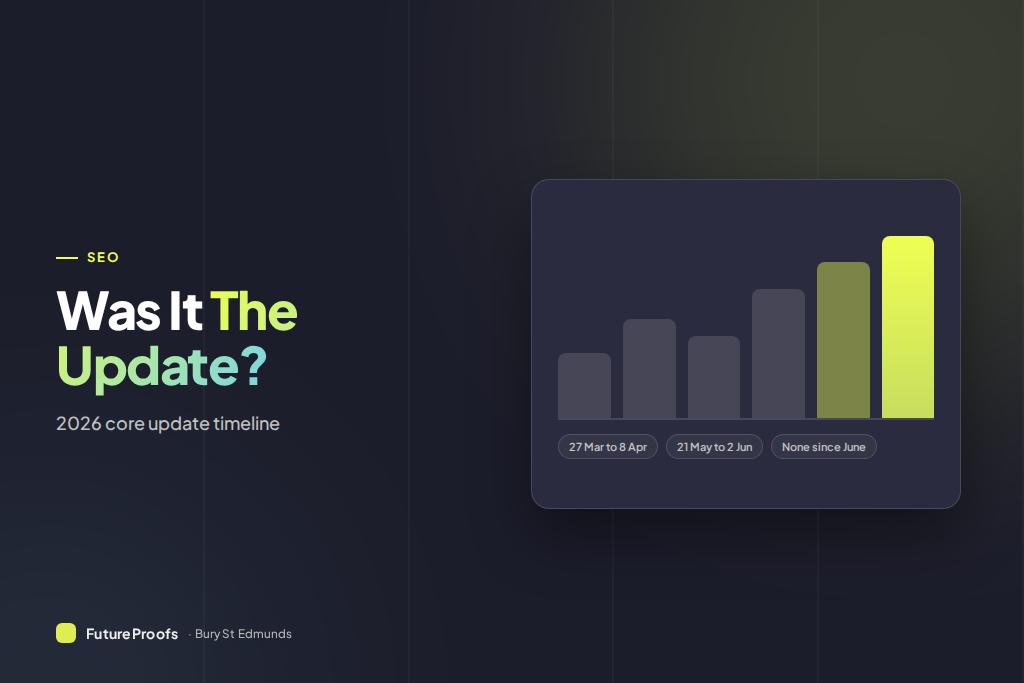
- The May 2026 core update ran from 21 May to 2 June, twelve days from announcement to completion.
- Google has confirmed no core update between the end of June and early September 2026, so an August drop was probably not an algorithm update.
- The correct response in the first week of a rollout is to change nothing and record exactly what moved.
- Recovery from a core update usually arrives alongside a later update, not the day after you edit a page.
What does a Google core update mean for a small business?
A core update is not a penalty. Nothing has been done to your site specifically. Google rebalances the hundreds of signals its main ranking system uses, all at once, in every language and country, and everybody's position is recalculated against everybody else's.
The exam analogy lands with most owners. Your answer paper did not change, the marking scheme did, and you can lose marks without writing a new word. Google's own description of the May rollout was that it was designed to better surface relevant, satisfying content from all types of sites. Deliberately vague, and vague for a reason: there is no single lever to pull.
The consequence matters more than the mechanism. Your ranking is relative. A competitor in Stowmarket rebuilding their service pages properly can push you down without you doing anything wrong, and no amount of staring at your own site will reveal it.
Which Google updates actually happened in 2026?
This is where owners get misled, because half the SEO industry labels every wobble an update. Here is the confirmed list, from Google's own Search Status Dashboard.
| Update | Dates | Length | What moved |
|---|
| March 2026 spam update | 24 to 25 March | Under a day | Spam policy enforcement, the shortest confirmed spam rollout on the dashboard |
| March 2026 core update | 27 March to 8 April | 12 days | Aggregators, directories and comparison sites lost ground; official and specialist sites gained |
| May 2026 core update | 21 May to 2 June | 12 days | Same direction again, with heavy movement in health, finance and thin ecommerce product pages |
| June 2026 spam update | 24 to 26 June | 2 days | Policy enforcement rather than a quality reassessment |
Two things are missing from that table on purpose. The reshuffle trackers recorded on 11 May was never confirmed by Google, so treat it as a community observation, though the direction it showed is real enough to be worth its own post on whether your website or a directory listing deserves the money. And the volatility reported in the first week of August 2026 appears nowhere on Google's dashboard. If a timeline article tells you there was an August core update, it is guessing.
Why does that matter in Bury St Edmunds? Because if you lost traffic in August and spend the autumn rewriting content to recover from an update that never happened, you have wasted the autumn.
How do you tell a core update from something you broke?
Five causes, one symptom. They leave different fingerprints, and you can check all five in about an hour with free tools.
The shape of the drop tells you most of it
A core update produces a gradual slide across many pages and queries, spread over days, inside a rollout window you can look up. A technical fault produces a cliff edge: one day normal, the next not, usually hitting one section or one page template rather than everything. If your chart falls off a table on a single Tuesday, stop reading about algorithms and go and look at your site.
Check for a technical cause before you touch a word of copy
- Robots.txt: a disallow line that arrived with a redesign and blocks a whole folder.
- Stray noindex tags: the single most common cause, usually pushed live from a staging environment.
- Redirects: a rebuild that mapped old URLs to the homepage instead of to their equivalent pages.
- Canonical tags: every town page pointing at the main service page, so Google keeps one and drops the rest.
- Hosting or firewall rules: bot protection that started refusing Googlebot after a security tightening.
- Sitemap: pages removed from it during a CMS migration and never added back.
If pages have vanished entirely rather than slipped down, the problem is indexing, not ranking, and the fix is a different one. That is worth reading separately, because a page that is not in the index cannot rank at any position and no amount of content work will change that.
Rule out the calendar
Compare year on year, not month on month. A Suffolk caterer is quiet in late August because half the county is away, not because of Google. A garage sees MOT peaks that follow the registration plate cycle. A wedding photographer's enquiries collapse after the February engagement rush, every year. Search Console compares the same period twelve months back in two clicks, and that one comparison ends a lot of panics.
Manual actions look completely different
Open the Manual Actions report in Search Console. If it says no issues detected, no human reviewer has penalised you, which is a genuinely different situation from a core update. Core updates never appear in that report, and they never arrive by email, whatever the message from an unfamiliar agency claims.
It might simply be a better competitor
Search your three most valuable queries in an incognito window and look at who sits above you now. If a firm in Newmarket has published fifteen properly written service pages since spring while you have four, the algorithm did not demote you. Somebody outworked you.
What should you do in the first week? Almost nothing
This is the unpopular part. During a rollout, the correct action is to change nothing and spend the time measuring instead. Change ten things while the index is still moving and you will never know which helped, and you will probably undo something that was working.
What to do instead, in about ninety minutes:
- Export Search Console performance data for the last 28 days against the previous 28, and again against the same 28 days last year.
- Note your top twenty pages by clicks and where each one sat before the rollout started.
- Split branded queries (your business name) from non-branded. A drop in non-branded only is an algorithm story; a drop in both is often a brand or seasonal story.
- Check Google Business Profile performance separately, because the map pack runs on a partly different system and often does not move when organic does.
- Write the rollout dates on the same document. In three months you will not remember them.
Reading your own numbers properly before reacting is most of the skill, and it has become more involved now that AI surfaces sit between the search and the click, which is covered in more depth in our guide to measuring how much traffic AI search is actually sending you.
What happened after the May 2026 core update settled?
Both 2026 core updates pushed in the same direction, and it is a helpful direction if you are a real business with a real address. Independent analyses of the March rollout found visibility moving away from aggregators, directories and comparison platforms toward official sites, specialists and institutional sources, with trackers recording nearly eighty per cent of top-three results changing position. May did more of the same, with the sharpest movement in health, finance and thin ecommerce pages.
The pattern for local service businesses across the summer was fairly consistent. Sites with genuine reviews, a real address, staff with names and a properly written page for each service they sell mostly came through it and settled back. Thin pages fed by aggregated data, and near-identical town pages produced by swapping one place name for another, largely did not recover, because there was nothing underneath them to recover to.
Recovery speed varies by what kind of site you run. A local business that lost ground on content quality tends to move within days or weeks of fixing the cause. A site whose whole model was reorganising other people's information is looking at months, if at all, because the problem is structural rather than editorial.
A core update recovery checklist
Once the rollout is confirmed complete, this is the order to work in. It is deliberately boring and none of it requires hiring anyone.
- Confirm the dates. Match your drop against the published rollout window before you assume causation.
- Segment by page. Find the five pages that lost the most clicks. Ignore the rest for now.
- Segment by query. A page can hold its rankings and still lose clicks if the query set changed shape above it.
- Read those five pages as a customer. Out loud. If you would not send the page to a friend who asked for a recommendation, it is not good enough.
- Add what only you know. Real prices or honest ranges, the streets you cover, named staff, the jobs you turn down, photographs of your own work rather than stock.
- Consolidate near-duplicates. Three pages saying the same thing about the same service compete with each other. Merge them into one strong page and redirect the others.
- Do not delete pages just because they dropped. Deleting is the most common mistake after an update. Restructure and improve first.
- Restart review collection. Reviews will not fix a core update drop directly, but they feed the local signals that keep the phone ringing while organic recovers.
- Fix the technical faults first. Indexing problems always outrank content problems.
- Wait for the next confirmed update before judging. Google has said repeatedly that meaningful improvement often only shows when the system next reassesses broadly.
If that list feels like a job rather than an afternoon, it is. Running the same sequence monthly and reporting on it honestly is what the SEO included in every FutureProofs website plan is for.
When it is not the algorithm at all
Some of the most alarming drops have nothing to do with ranking systems. A Google Business Profile gets suspended after an address edit and map pack traffic disappears overnight. A business moves premises and the old address survives on forty directory listings, so the local signals contradict each other. Somebody pauses a Google Ads campaign and the total traffic line falls while organic sits still.
There is a newer one worth naming. Impressions hold, average position holds, and clicks fall anyway. That is usually the query set moving into AI surfaces, where the answer is assembled above the results. It feels like a ranking drop and it is not one, and the response is different: be the source that gets cited rather than the tenth blue link.
For businesses competing in one town, the local picture is worth separating from the national one entirely, which is the thinking behind how we approach local search for Bury St Edmunds businesses rather than treating every query the same way.
Frequently asked questions
How long does a Google core update take to settle?
Recent core updates have taken about two weeks. The March 2026 core update ran from 27 March to 8 April and the May 2026 core update from 21 May to 2 June, both roughly twelve days. Volatility usually comes in waves rather than steadily, so a position on day three tells you very little. Wait for the confirmed completion date before drawing conclusions.
My rankings dropped after a Google update, what should I do first?
Measure before you change anything. Export your Search Console data for the affected period, compare it with the previous month and the same month last year, and identify the specific pages and queries that lost clicks. Only then decide what to improve. Editing widely during a rollout destroys your ability to learn what actually worked.
Was there a Google core update in August 2026?
No. Google confirmed no core update between the June 2026 spam update, which finished on 26 June, and early September 2026. Plenty of people reported volatility in the first week of August, but Google's Search Status Dashboard logged no ranking, indexing or serving incident in that window, so an August drop is more likely to be seasonal or site-specific.
How long does it take to recover from a core update?
Usually weeks to months, and often only when a later update runs. Google has said many times that significant improvement frequently appears alongside the next broad reassessment rather than immediately after you make changes. Local service businesses tend to move faster than aggregator-style sites, because their problems are editorial rather than structural.
Can a small local business really be hit by a core update?
Yes, though usually less severely than national content sites. Local businesses are protected slightly by the fact that map pack results run on a partly separate system, so organic pages can slip while calls from Google Business Profile hold steady. The exposure comes from thin service pages and duplicated town pages, which both 2026 core updates treated harshly.
Should I delete the pages that lost rankings?
Almost never. Deleting content that dropped is the single most common recovery mistake, because it removes the pages Google might have re-evaluated favourably. Improve them, merge genuine duplicates into one stronger page with a redirect, and only remove pages that have no purpose at all, such as an old offer that no longer exists.
Where this leaves you on Monday morning
The businesses that handle updates well are not the ones with the cleverest tactics. They are the ones who can tell a rollout from a redirect from a wet fortnight in August, because they were already reading their own numbers before anything went wrong. That habit costs nothing and turns a fortnight of anxiety into an hour of checking.
The second thing they share is pages worth ranking. Real prices, real photographs, the villages they cover, the questions customers ask on the phone. Both 2026 core updates rewarded that and punished the alternative, and there is no reason to expect the next one to reverse.
If you have had a drop and you would rather someone experienced looked at the data with you than guess for another month, a second opinion on the data is usually a faster route than a rebuild. Either way, start by writing down the dates.
When you want a second opinion on what moved and why, tell us what happened and when and we will take a look.