Somebody has quoted you for answer engine optimisation. It is a four figure number, it comes with a slide deck, and before you sign it you would quite like to know what Google itself has said on the subject, as opposed to what the agency selling it says Google said.
The Google AI Overviews guidelines went up on Search Central on 15 May 2026, alongside a spam policy update, and they are the only document with Google's name on them that addresses the question directly. It is short, it is duller than the industry made it sound, and one line in it undercuts most of what is being sold. Four months on, we have watched what actually happened to client sites in Bury St Edmunds, Newmarket and Ipswich across the summer, and the interesting part is not what Google said. It is which bits held up.
This post goes through the guidance claim by claim with a verdict on each: load-bearing, restated old advice, or a question Google conspicuously declined to answer.
Key takeaways
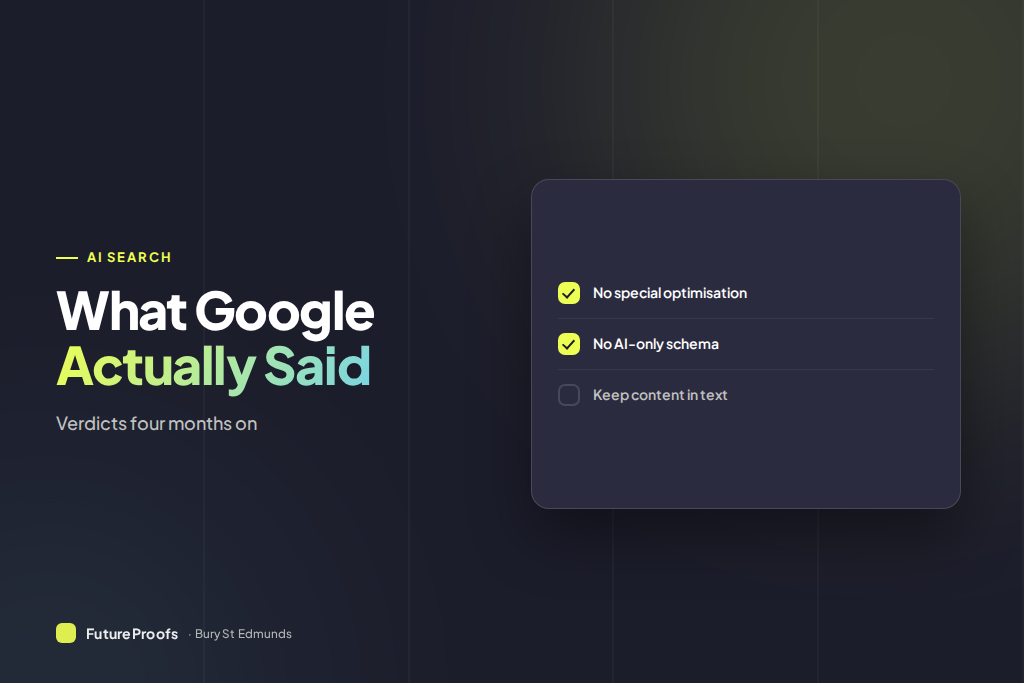
- Google's own documentation states there are no additional requirements to appear in AI Overviews or AI Mode, and no special optimisations necessary.
- Google explicitly says no new machine-readable file, AI text file or special schema.org markup is needed to appear in its AI features.
- The load-bearing advice is keeping important content in text, making structured data match what is visible on the page, and keeping your Google Business Profile current.
- Google's 15 May 2026 spam policy update extended existing spam rules to cover attempts to manipulate generative AI responses, with the same demotion and removal penalties.
- Google publishes no data on what a citation is worth; the figures in circulation come from Ahrefs and Seer Interactive, not from Google.
What Google actually published on 15 May 2026
Two things landed together, and they get conflated constantly. The first was a changelog entry extending the search spam policies, in Google's words, to make it clear that the spam policies apply to all of Google Search, including generative AI responses. The policy text now names manipulating generative AI responses alongside manipulating rankings, and the penalties are the same ones that have always applied: demotion or removal. There is no separate appeals route and no carve-out. We covered the practical consequences of that in our post on agencies selling AI citations.
The second was the first official guidance on optimising for the generative AI features in Search. That is the document worth reading, and it takes about four minutes. If you have never read Google documentation before, the tone is a shock: it spends more effort telling you what you do not need to do than what you do.
Google AI Overviews guidelines, with a verdict four months on
Here is every substantive claim in the document, what it means for a business with twelve pages, and how it has held up since May.
| What Google says | What that means | Verdict, September 2026 |
|---|
| No additional requirements or special optimisations are needed to appear in AI Overviews or AI Mode | There is no separate AI checklist, because Google says one does not exist | Held up. No AI-specific ranking factor has surfaced in four months. |
| No new machine-readable files, AI text files or special schema.org markup are required | llms.txt and AI-specific markup are not entry requirements | Held up. Google has given no sign of adopting any of them. |
| Pages must be indexed and eligible for snippets | Block snippets and you block yourself from the AI surfaces | Held up, and now controllable directly since August 2026. |
| Keep important content in text | Anything locked in an image, a video or a script cannot be quoted | Load-bearing. The single most actionable line in the document. |
| Structured data must match visible page content | Schema describes the page, it does not make claims for it | Load-bearing, and where most small sites quietly fail. |
| Keep Business Profile and Merchant Center information current | Your hours, address and services feed the answer directly | Load-bearing for local firms, and the only local-specific line Google offers. |
| Good page experience, internal linking, quality images and video | The Search Essentials, unchanged | Restated. Nothing new in it at all. |
The parts that turned out to be load-bearing
Keeping the important content in text
This sounds trivial until you look at real Suffolk small business sites. Prices sitting inside a designed price list image. Opening hours baked into a graphic on the homepage. A menu delivered as a PDF. A service list that only exists inside a slider that loads on scroll. All of it invisible to the thing deciding whether to quote you. We have moved price and hours out of images on more client sites this summer than we have done anything else, and it is a half hour job.
Structured data that matches what a human sees
Google's phrasing is precise: verify that structured data matches the visible page content. The failure we find most often is a LocalBusiness block claiming opening hours the site itself contradicts, usually because the schema was written two years ago and the shop changed its Saturday hours. Schema describes a page. It does not override it, and a mismatch is a reason to distrust everything else you have marked up. Our post on what schema markup does and does not do covers the implementation properly.
The Business Profile line
Buried in a list of technical recommendations is the only sentence in the whole document aimed squarely at a local business: keep your Business Profile current. For a plumber covering Stowmarket and the villages, or a clinic off Risbygate, that profile is doing more work in AI answers than the website is. It is also free, and it takes twenty minutes.
The pattern we saw across the summer supports it. On the client sites where an AI answer named the business on a local query, the profile was complete, the categories were right and the hours matched the website. Where the answer named a directory instead, the profile was usually two years old with a stale category and a phone number that had changed. That is not proof of causation, and we would not sell it as such, but it is the only consistent difference we could find.
The parts that were existing SEO documentation relabelled
Roughly half the guide is the Search Essentials with a new introduction. Read those lines next to any AEO proposal you have been sent and you will recognise most of the deliverables.
- Allow crawling in robots.txt. Standard technical setup, and a five minute check.
- Use internal links so pages are discoverable. Site architecture, unchanged since 2011.
- Provide a good page experience. Core Web Vitals under a new heading.
- Support text with quality images and video. Advice Google has given since long before generative answers existed.
None of that is wrong and none of it is new. If an agency has quoted you for answer engine optimisation on the strength of those four lines, you are being charged a second time for work that should already sit inside your search programme.
This is the honest reading of the whole document, and it is the position we took before Google published it: answer engine optimisation is not a separate discipline. Our guide to what answer engine optimisation actually is makes the case at length. Google's guidance is the closest thing to official confirmation that the acronym is a packaging exercise.
Where Google is conspicuously silent
What a document leaves out tells you as much as what it includes, and there are four gaps worth naming.
- How sources are chosen. Google says a page needs to be indexed and snippet-eligible. It never says how the model picks three sources out of the ten thousand that qualify.
- What a citation is worth. No click data, no traffic data, no comparison against a normal top result. Every number you have seen on this comes from a third party.
- Anything about local specifically. One line about Business Profile, and that is the lot. For a business whose entire market is thirty miles wide, that is a thin document.
- Whether AI Mode behaves like AI Overviews. The guidance treats them as one surface. Practitioners increasingly do not.
The silence on source selection is the important one, because it is precisely the gap the AEO industry fills with confident claims. Nobody selling you a citation package knows how sources are chosen either.
What the independent data shows and Google does not say
Google will not tell you what any of this is worth, so the numbers come from elsewhere and should be attributed as such. Ahrefs, publishing in February 2026, found the top organic result keeps only 42 of every 100 clicks it used to receive when an AI Overview is present, a fall of 58%. Seer Interactive, measuring in September 2025, found brands cited inside an Overview earned roughly 35% more organic clicks than uncited brands on the same query.
Those two figures are the whole argument in one line. The visibility that used to come from ranking first has been cut roughly in half, and some of it has moved to whoever gets named in the answer. Neither figure is Google's, neither is UK-specific, and neither should be quoted at you as though Google published it.
What Google has added since May
The most useful development came on 31 August 2026, when Google rolled the generative AI performance reports in Search Console out worldwide. You can now see impressions, pages, countries, devices and dates for your appearances in AI features. You cannot see clicks, which is a real limitation and worth knowing before you build a report around it.
The same rollout added a control letting a site opt out of appearing in AI Overviews, AI Mode and AI Overviews in Discover. Google was unusually clear about the consequences: opted-out sites receive no traffic or impressions from those features, and the control is not used as a ranking signal for normal web search. That is a cleaner trade than the debate suggested. You lose the AI surfaces, you keep your rankings, and for almost every local business that is a bad deal because being named in a local answer is the thing you want.
Frequently asked questions
What does Google say about optimising for AI Overviews?
Google states there are no additional requirements to appear in AI Overviews or AI Mode and no special optimisations necessary. Its guidance asks for the same things as normal search: crawlable, indexed, snippet-eligible pages with important content in text, structured data matching what is visible, and current Business Profile details.
Is there official Google guidance for AEO?
Yes, published on 15 May 2026 in Google Search Central, though it never uses the term AEO. It is a short page on optimising for generative AI features, and its central message is that no separate discipline exists. Anyone quoting you for AEO as a distinct service is selling a label Google itself does not recognise.
Do I need special schema markup for AI Overviews?
No. Google's documentation says explicitly that no new machine-readable files, AI text files or special schema.org structured data are needed. Standard structured data still helps, but only where it accurately describes content a visitor can actually see on the page. A mismatch between markup and visible content is a liability, not a shortcut.
How does Google choose AI Overview sources?
Google has not said. The guidance confirms only that a page must be indexed and eligible for snippets to be considered. Beyond that, source selection is undocumented, which is worth remembering whenever an agency claims a method for guaranteeing citations. Nobody outside Google knows how the shortlist is drawn.
Can I stop my site appearing in AI Overviews?
Yes. Since 31 August 2026 Search Console has carried a control that opts a site out of AI Overviews, AI Mode and AI Overviews in Discover. Google confirmed it is not used as a ranking signal for ordinary web search, so rankings are unaffected, but opted-out sites get no impressions or traffic from those features at all.
Has any of Google's May guidance been contradicted since?
No. Four months on, nothing in the document has been walked back or replaced, and no AI-specific ranking factor has emerged to contradict it. The only material change is the August 2026 Search Console rollout, which added measurement and an opt-out control rather than altering the underlying advice.
Should you pay for AEO as a separate line?
On the evidence of Google's own documentation, no. Every action in that guide is either standard technical search work or content work, and both should already sit inside whatever you pay monthly for search. A quote that separates AEO out as a new service line is usually charging you a second time for structured data, page speed and content writing under a newer name.
What is genuinely worth paying for is the work the guide implies without saying: getting your prices, hours and service areas out of images and into text, keeping structured data honest as the business changes, writing pages that answer the questions people ring you about, and keeping the Business Profile accurate. That is unglamorous and it is exactly what a proper content plan and the search work in every plan is for. For a firm in the town, our Bury St Edmunds local search page sets out how that runs month to month.
If you want the sequenced version, with the free hour-one items separated from the work that needs a developer, our AI search readiness checklist is the doing version of this post, and the AI Overviews explainer covers the mechanism underneath.
Read Google's guidance yourself before you sign anything, then check what your current search programme already covers against it.