You have probably seen the AI Mode tab sitting alongside Images and Maps, and you may have typed a question into it to see what came back. What comes back is not ten blue links. It is a written answer, two or three named businesses, and a short stack of citations off to the side. So the question owners keep asking is the sensible one. Is Google AI Mode a separate ranking game, or the same game with different wallpaper?
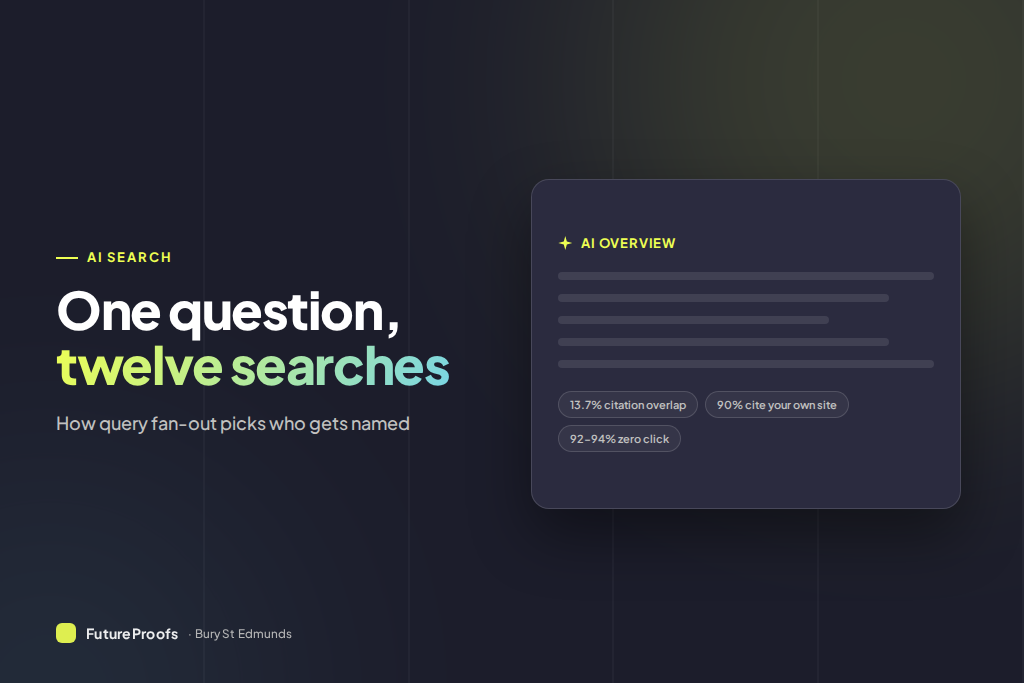
It is the same underlying index, read in a completely different way, and that difference is big enough to change what you should build. Google said in May 2026 that AI Mode had passed a billion monthly users. Ahrefs compared roughly 540,000 matched query pairs and found the URLs cited in an AI Overview and the URLs cited in AI Mode for the same question overlap only 13.7 per cent of the time. Being in one is not being in the other.
This post covers the two things that decide whether your business gets named: query fan-out, which is why one question quietly becomes a dozen searches, and the weight of community content in the answer. It ends with what a plumber in Stowmarket should do about it, and one thing you should not bother doing at all.
Key takeaways
- AI Mode and AI Overviews cite the same pages for the same query only 13.7 per cent of the time, so ranking in one does not put you in the other.
- AI Mode uses query fan-out, running several related searches behind one question, which favours sites with a page per question over one fat homepage.
- A UK study of 159 AI Mode answers across 20 towns in August 2026 found the business's own website cited in 90 per cent of them and Google reviews or Business Profiles in 81 per cent.
- Reddit lost 86 per cent of its ChatGPT citations in August 2026, which is why building a strategy on forum posts is building on someone else's platform decision.
- Between 92 and 94 per cent of AI Mode sessions end without a click, so being named in the answer matters more than sitting at position three.
What is Google AI Mode, and how is it different from AI Overviews?
An AI Overview is a summary bolted to the top of a normal results page. The ten links are still underneath it. AI Mode is a different surface entirely: you ask, it answers, you ask again, and the whole page is the conversation. It arrived in the UK on 28 July 2025 and Google confirmed in June 2026 that it has no plans to make it the default behaviour in Chrome, so for now it is a tab people choose rather than a thing that happens to them.
Google has been open that the two surfaces use different models and different techniques, and the citation data bears that out. If you want the mechanics of the summary that sits above the links, the companion piece on how AI Overviews pick their sources covers that surface properly. This one is about the tab.
| Surface | What triggers it | Where the answer comes from | What you can influence |
|---|
| Classic results | Any query, always present under the AI block | One ranked list of pages | Rankings, titles, page speed, links |
| AI Overviews | Informational and comparison queries on a normal results page | A short summary built from a handful of top-ranking pages | Being in the top few results, and writing answers that are liftable |
| AI Mode | The user deliberately opens the tab, then keeps asking | Many parallel searches, stitched together, citing around seven domains per answer | Breadth of pages, plain-text specifics, Google Business Profile, reviews |
Two consequences. First, 97 per cent of AI Mode answers carry at least one citation, so there is a real slot to win. Second, Search Console counts every follow-up as a separate query, so one customer thinking out loud about a bathroom refit gives you five chances to be named, or five to be missed.
Why one search now becomes a dozen searches
Query fan-out is the mechanism underneath AI Mode, and it is the single most useful thing for a business owner to understand. Instead of taking your question and ranking pages against it, Gemini breaks the question into sub-questions, runs them in parallel, reads what comes back and assembles a reply. Ask it for a bathroom fitter in Bury St Edmunds and the machine is not running one search. It is running something closer to this:
- The obvious one. Bathroom fitters in Bury St Edmunds and the surrounding villages.
- The qualifying one. Which of them are insured, and are they on a competent person scheme.
- The money one. What a full bathroom refit costs in Suffolk in 2026.
- The timing one. How long a small bathroom takes and what the lead time looks like.
- The trust one. What recent customers said, and whether anyone has complained.
Then it merges the results. You do not have to rank first for the head term to be named. You have to be the clearest source for one of the sub-questions and be credible enough on the others not to get filtered out.
What fan-out rewards
Surface area, in the literal sense. A firm with a homepage, six service pages, two town pages and a steady run of articles has ten or more chances to be picked up inside one fan-out. A firm with a homepage and a contact form has one, and that page has to be the best answer on price, process, area and reputation at once, which no page ever is. It is why we build a researched page for every service in every town rather than stamping out a template, and why Hannah's Medical Aesthetics in Newmarket ended up as a 26 page build.
What fan-out punishes
Vagueness, and pages that answer half a question. A services page that says we offer a range of bathroom solutions tailored to your needs answers none of the five sub-questions above. It does not get quoted, because there is nothing in it to quote. The pages that get pulled in are the ones with a number, a name, a place and a timeframe in a sentence a machine can lift without editing.
Why forums, reviews and community posts turn up in the answer
Google leaned into community content during 2026 because summaries of official pages read like brochures and people stopped trusting them. AI Mode now quotes a forum thread or a review next to the tidy corporate sentence, so your off-site reputation is no longer a separate channel from your search visibility. What most agencies get wrong is the ranking of those sources. The instinct is to chase whatever feels loudest. The data says otherwise.
What a UK study of AI Mode answers actually found
In August 2026 Whito checked 159 Google AI Mode answers across eight sectors and 20 UK towns, all of them local service queries of the kind a Suffolk business would care about. The share of answers citing each source type came out like this:
- The business's own website: 90 per cent. The single most cited source, by a distance.
- Google reviews and Business Profiles: 81 per cent. Also yours, also free.
- Trade directories: 53 per cent. Useful, but a supporting act.
- Regulators and trade bodies: 45 per cent. Worth being listed with yours.
- Reddit and Facebook: 32 per cent. Real, but not the main event.
- Trustpilot: 1.3 per cent. News outlets: zero.
Nearly every answer in that sample leaned on the website, the Google presence, or both. Yext, working from a much larger set of 6.8 million citations, found 86 per cent of AI citations come from brand-managed sources once you control for intent and location. The two things that decide whether an AI names you are the two things you already own outright.
Is farming Reddit a strategy? No
Here is the opinion, and it is not the fashionable one. Paying someone to seed threads about your business on Reddit is not a plan. It is a rented position on a platform that can reprice you overnight, and in August 2026 it did exactly that: Reddit's share of ChatGPT citations fell by around 86 per cent after a change on OpenAI's side, reported by Axios on 20 August. Anyone who had spent the summer building visibility on that one source lost most of it in a fortnight, and they had no say in it.
There is a measurement trap too. Aggregate counts make forums look enormous, somewhere between 21 and 40 per cent of citations, but Yext puts genuine forum influence closer to 2 per cent once you account for the kind of query being asked. Forums dominate the questions where nobody has a commercial answer. They matter far less on emergency electrician Haverhill, where an actual electrician's page beats a stranger's opinion.
Being genuinely discussed is a different thing and worth having. If people in a Bury St Edmunds Facebook group name you unprompted when someone asks for a groomer, that signal was earned. What matters is whether the mentions exist because customers wanted to write them or because you paid for them. Google has said plainly that manufactured citations are a spam problem, and the difference is visible to anyone reading the thread.
How do I show up in Google AI Mode?
Nothing here is exotic. It is clear writing and sane structure, applied to a surface that reads rather than ranks. For the sequenced version with the effort ranked, work through the AI search readiness checklist.
Give every real question its own page
List the ten questions you get asked on the phone before anyone books. Price, area covered, how long it takes, whether you are insured, what happens if something goes wrong, whether you do evenings. Each of those deserves a heading and a proper answer somewhere on the site. That is the surface area fan-out needs, and it is also just a better website for the person reading it. It is the same thinking behind SEO for Sudbury businesses, where each service in each village gets its own page.
Put the specifics in plain text
Prices, opening hours, service areas and phone numbers must be selectable text in the page, not baked into an image or generated by a script after the page loads. A number inside a graphic is invisible to everything that reads your site. This is the single most common reason a perfectly good Suffolk business gets skipped in an answer that names two competitors.
Treat the Google Business Profile as your second website
Cited in 81 per cent of those UK answers, and most of it is fields you can fill in this afternoon. Categories, hours including bank holidays, service list, service area, photos taken this year. Half the profiles we audit have an empty services list and hours last correct in 2024.
Get reviews that say what you did
Ten reviews that name the job, the town and the outcome are worth more than a hundred that say great service. The review text becomes the phrasing an AI uses when it recommends you, which is why where your reviews live and how they are marked up now affects visibility rather than just persuasion.
What to check this week
Half a day, no budget, in this order.
- Run five real customer questions through AI Mode with the location set to your town, and write down who gets named.
- Read your own site as a machine would. Turn off images in the browser. If the price, the phone number or the service area vanishes, fix that first.
- Fill the Google Business Profile properly. Every category, every service, correct hours, recent photos.
- Pick the two sub-questions you lose on from step one and write a page for each, with the numbers in it.
- Ask the last ten happy customers for a review and prompt them to name the job and the town.
Do that and you have covered the two sources that appeared in almost every answer in the UK sample. The rest is maintenance, which is what the ongoing search work inside every plan is for.
Frequently asked questions
Is Google AI Mode replacing normal search results?
No. Google confirmed in June 2026 that it does not plan to make AI Mode the default search behaviour in Chrome, so it remains a tab people choose. Classic results still sit under every AI Overview. What has changed is that a growing share of considered, comparison-heavy searches now happen in a conversation instead of a list.
Do I need different content for AI Mode than for normal SEO?
No, you need the same content written more plainly and spread across more pages. The index is shared, so a page that ranks well is already a candidate. The difference is that AI Mode lifts sentences rather than links to them, so specifics stated in plain text get quoted and marketing language gets skipped over entirely.
Why does Google quote Reddit and forums in AI answers?
Because unedited human experience makes a synthesised answer feel trustworthy where official copy does not. Forums appeared in around a third of UK local answers studied in August 2026. They are a genuine input, but a much smaller one than your own website and your Google Business Profile, and their weight can change without warning.
How is AI Mode different from AI Overviews for my business?
They are separate surfaces with separate citation pools, overlapping only 13.7 per cent of the time in a study of around 540,000 query pairs. An Overview usually rewards being in the top handful of results for one query. AI Mode rewards having a credible answer to several related sub-questions, which favours depth of site over a single strong page.
Can I track how often AI Mode shows my business?
Partly. Search Console's generative AI performance report shows impressions from AI Overviews and AI Mode, broken down by page, country, device and date. It does not give you clicks or the queries that triggered them, so treat it as a visibility trend rather than a traffic report, and run manual checks alongside it.
Does AI Mode kill my website traffic?
It reduces clicks and concentrates them. Between 92 and 94 per cent of AI Mode sessions end without anyone clicking through, against 34 to 43 per cent on classic search. The people who do click have already been filtered, so they arrive further along. The risk is not fewer visits, it is being absent from the shortlist entirely.
Where this leaves a Suffolk business
AI Mode is not a new algorithm to game. It is a reader, and it reads your site the way a careful customer would if they had time to check five things at once. The businesses being named in these answers across Suffolk and the towns around it are not the ones with clever tricks. They are the ones whose website says what they charge, where they work and how long they take, in words, on a page, with a Google profile that matches.
The uncomfortable part is that this rewards breadth, and breadth takes time. One homepage cannot be the best answer to a price question, an area question and a trust question at once. That is a content problem, not a technical one, and no plugin fixes it.
Start with the five questions your customers ask on the phone. If you would rather someone else worked through it with you, tell us what you sell and where you sell it and we will show you which sub-questions you currently lose.