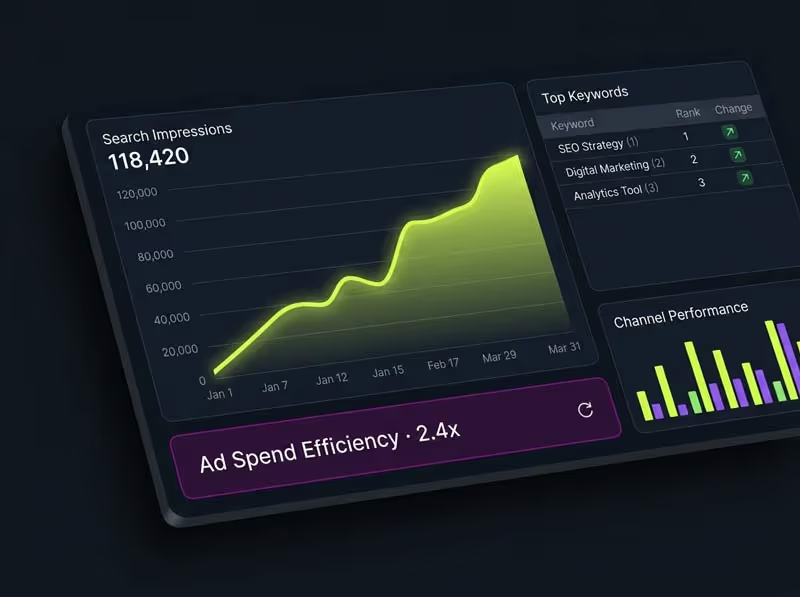
Your rankings have not moved. Your Search Console impressions are flat or up. Your clicks are down by a third, and have been since the spring. Nothing on your website broke, and nobody can tell you what you did wrong, because you did not do anything wrong.
What happened is that Google started answering the question above your listing. Google AI Overviews affect a small business in a way that looks like a penalty on the way in and turns out not to be one, and the useful response is quite different from the panic response. This post explains the mechanism: what makes an Overview appear at all, where the businesses it cites come from, why local searches behave so differently from informational ones, and what has actually settled in the four months since the spring rollout.
It is deliberately not a statistics post or a policy summary. Those exist separately and are linked where they belong.
Key takeaways
- An AI Overview is a generated summary above the organic results, produced by Google's Gemini models reading and synthesising pages from the web.
- Overviews trigger heavily on informational and comparison questions and far less on local intent searches, so the map pack remains largely intact for town level queries.
- Google reported in May 2026 that Overviews appear on roughly 40 percent of searches, with click through rates falling by as much as 61 percent on queries where one is shown.
- Search Console's generative AI performance reports went global on 31 August 2026 and give impressions, pages, countries, devices and dates, but no click or query data.
- Google has confirmed that opting out of AI features does not affect ordinary rankings, which makes blocking a genuine choice rather than a threat.
What Google AI Overviews are and what triggers one
An AI Overview is a block of generated text at the very top of a Google results page, written by Gemini after reading a set of pages it retrieved for that query, with a handful of source links attached. It is not a snippet lifted from one page. It is a fresh paragraph assembled from several, which is why a business can be described in an Overview using words that appear nowhere on its website.
Overviews do not appear on everything, and the pattern of where they do is the single most useful thing to understand. They trigger most reliably on questions: how, why, what is the difference between, how much does, is it worth. They trigger on comparison and research queries where the user clearly wants an explanation rather than a destination. They appear far less on navigational searches, where someone already knows the business they want, and far less again on local intent searches with a town attached.
So the exposure is not evenly spread across your website. A guide page explaining what underfloor heating costs is in the firing line. Your Newmarket service page is largely not. Most owners discover this the hard way by looking at aggregate traffic, panicking, and only later noticing that the pages losing clicks are all top of funnel.
Where the cited sources come from
The links beside an Overview are not the top organic results reworded. Google retrieves a set of candidate pages, generates the answer, then attributes the parts it used, which means a page ranking eighth can be cited while the page ranking first is not. That is genuinely different from how featured snippets worked, and it is the reason ranking reports alone stopped telling the whole story this year.
What the cited pages tend to have in common is dull and encouraging. They answer the specific question early in the page rather than after four paragraphs of preamble. They contain a number, a timescale or a named thing that can be repeated. They are on sites Google already treats as a reasonable authority for that subject. And they are structured, with headings that match the shape of the question, which is where properly implemented schema markup earns its place: it removes the guesswork about what a page is and who published it.
The uncomfortable consequence is that being cited does not guarantee a visit. Your name and your sentence can appear at the top of the page while the click goes nowhere, and that is the trade the whole industry is currently arguing about.
Why local searches behave differently
This is the part that matters most for a business serving a defined patch of Suffolk or Cambridgeshire, and it is genuinely good news.
The map pack has not been displaced
Search for plumber Bury St Edmunds, dog groomer Stowmarket or accountant Ely and the page still looks broadly the way it did two years ago: a map, three business listings, reviews and phone numbers, then organic results. Overviews appear on these searches far less often, because Google already has a purpose built answer format for local intent and a generated paragraph adds little to it. Your Google Business Profile, your reviews and your location pages are doing the same job they were doing before. A bigger town changes nothing here, and SEO for Ipswich businesses still comes down to the map pack and the village pages.
The queries that did take the hit
What changed is the layer above that. The searches people run before they are ready to pick a supplier, how much does a bathroom refit cost, do I need planning permission for a garden room, what is the difference between a combi and a system boiler, are exactly the questions Overviews handle best. If your blog was built to catch that traffic, that is where the missing clicks went.
The strategic answer is not to abandon that content. It is to accept that its job changed. Top of funnel pages now earn brand impressions and citations rather than sessions, and the pages that earn enquiries are the specific, local, transactional ones. That is a reason to keep investing in search work across the Suffolk towns you actually serve rather than in another general guide.
What has actually settled since the spring
Four months on from the May 2026 rollout, three things look clear that were not clear at the time.
Coverage kept climbing through the summer rather than plateauing. The sky did not fall for businesses with strong brand and review signals; the firms that lost the most were those whose traffic was overwhelmingly informational and unbranded. And the measurement fight got a lot noisier, because published figures for Overview prevalence now range from around 20 percent to well over 40 percent depending on whose clickstream data is used and which country it covers. Google's own May figure was roughly 40 percent of searches, with click through rates on affected queries falling by up to 61 percent. Independent panel studies published since have produced lower prevalence numbers and similar click through findings.
Do not spend an afternoon reconciling those. The direction is not in dispute and the exact percentage does not change what you would do on Monday. If you want the UK specific numbers and their sources set out properly, they are collected in our post on how many UK searches now show an AI Overview.
One more thing settled. AI Mode, the full conversational search experience, is a separate surface with different behaviour, and it is worth keeping the two apart in your head; we cover it in what Google AI Mode means for a small business.
How to see what this has done to your own site
Guessing from aggregate traffic is how people reach the wrong conclusion. There is now a direct measurement, and it is free.
Search Console's generative AI performance reports rolled out globally on 31 August 2026, having been announced in June. They show how often your pages appeared in Google's AI experiences, broken down by page, country, device and date. What they do not show is clicks or queries. That omission is deliberate and it is significant: you can see that you were included, but not what it was worth or what was asked. Treat the report as a visibility signal, not a traffic report, and pair it with your ordinary performance data rather than reading it alone. The practical method for doing that is covered in our guide to measuring AI search traffic in Search Console.
Alongside the report, do the manual version once a month. Run your ten most commercially important searches in an incognito window, note whether an Overview appears and who is cited in it, and keep the screenshots. Ten minutes, and it tells you things the report cannot.
What a small business should do about Google AI Overviews
Different pages need different responses, and treating the whole site the same is why so much of the advice on this subject feels useless.
| Query type | What Overviews did | What to do |
|---|
| Local, town attached | Little change; map pack intact | Keep the profile, reviews and town pages strong |
| Branded, your name | Little change | Make sure your own site states the facts clearly |
| Informational, no location | Heaviest click losses | Write to be cited; accept fewer sessions |
| Price and cost questions | Overviews frequently shown | Publish real numbers, which almost no local firm does |
| Comparison questions | Overviews frequently shown | Give a genuine answer, including when you are wrong |
Two practical notes on that table. First, price pages are the biggest open goal in local search right now, because Overviews are asked constantly what things cost and almost nobody local publishes a figure. Second, the comparison row means what it says: a page that admits when a competitor's product suits the reader better is far more likely to be treated as a reliable source than one that does not.
What is not worth doing
Three things people are currently spending money on that are not worth it.
- Blocking AI features out of protest. Google has confirmed that opting out of AI features does not affect your ordinary rankings, so it is a real choice rather than a hostage situation. It is still the wrong choice for almost every local business, because you lose the impressions and gain nothing.
- Buying citations or guaranteed AI placements. There is no slot to buy, and Google's spam policies now cover its generative features explicitly.
- Rewriting your whole site for AI. The pages that matter are your service and location pages, and they mostly need specifics added rather than a rebuild.
What is worth doing is unglamorous and familiar: consistent details, complete profile, real reviews, pages that answer real questions with real numbers. Google's own published guidance on the subject says much the same thing, and we assessed how well it has held up in our review of Google's first official AEO guidance.
Frequently asked questions
What are Google AI Overviews?
Google AI Overviews are generated summaries that appear above the organic results on many searches, written by Google's Gemini models after reading and synthesising several web pages, with source links attached. They are not quotations from a single page. They appear most often on questions and comparisons, and much less often on local searches with a town name attached.
Do AI Overviews reduce clicks to small business websites?
On the queries where they appear, yes. Google's May 2026 figures showed click through rates falling by as much as 61 percent on affected searches. The losses concentrate on informational pages rather than local service pages, so a business whose enquiries come from town level searches typically sees far less impact than one relying on general guide content.
How do I appear in AI Overviews?
Answer the specific question in the first sentence under each heading, include numbers, timescales and named places that can be repeated, use headings that match how people phrase the question, and add structured data so Google knows what the page is. There is no submission process and no paid inclusion, so being cited is a consequence of being useful and legible.
Do AI Overviews affect local searches in Suffolk?
Much less than informational searches. Queries such as electrician Haverhill or dentist Bury St Edmunds still return the map pack, reviews and organic listings in close to the traditional layout, because Google already has a dedicated local answer format. Local SEO and a complete Google Business Profile remain the highest return work for a business serving a defined area.
Can I stop my site appearing in AI Overviews?
Yes, through the available AI feature controls, and Google has confirmed that opting out does not affect your normal search rankings. For most local businesses it is still a poor trade, because you give up brand impressions in the most prominent block on the page in exchange for no measurable benefit. Publishers with paid content have a stronger case.
Should I stop investing in SEO because of AI Overviews?
No, because the work that earns a citation is the same work that earns a ranking. Consistent business details, fast pages, structured data, genuine reviews and specific content serve both. Cutting search investment now generally means losing ground in the ordinary results and the AI answers at the same time, which is the worst of both outcomes.
The honest summary for a Suffolk business
If most of your work comes from people searching your trade plus your town, AI Overviews have changed less for you than the headlines suggest, and the right response is to carry on doing local search properly rather than to start an AI project. Check your generative AI report, look at which pages actually lost clicks, and you will usually find the losses sit in blog content that was never generating enquiries anyway.
If a meaningful share of your enquiries came from informational content, the change is real and it is not reversing. The response is to shift the balance of what you publish towards the specific, the local and the priced, and to accept that some of your writing now exists to be quoted rather than visited. That is a worse deal than 2019 offered. It is still a better deal than being absent from an answer your competitor is named in.
Either way, the underlying work is the same ongoing search work you should already have running, and it sits inside a monthly website plan rather than a separate AI retainer.
If you want to know which of your pages are actually affected, the plans and what is included in each are set out at our published pricing.