You have 4.9 stars and sixty reviews. The most recent is from March last year and you can still remember the customer who left it. The salon that opened two doors along eighteen months ago has thirty one reviews, four of them from the past fortnight, and it sits above you in the map pack every time.
That gap is not about quality or how long you have traded. It is freshness, and it is the most fixable problem in local search. This post answers how to get more Google reviews from a profile that has gone quiet: a thirty day plan you can run yourself, the two messages that actually get replies, the exact moment in a job to send them, and three reply templates including one for a review that stings.
No software required. Buy some later if you want it. The habit has to survive a wet Tuesday with a phone in your hand before it is worth automating.
Key takeaways
- Review recency ranks as the eleventh strongest local pack factor in Whitespark's 2026 Local Search Ranking Factors report, scoring 164.
- Send the request 24 to 48 hours after the job finishes, by text, with a link that opens the review box directly rather than the profile.
- Reply to every review, not only the complaints. The reply is the half of the signal most owners skip.
- Offering a discount, a free coffee or a prize draw entry in exchange for a review breaches Google's policy and can get the reviews stripped.
- Twenty recent reviews with a steady trickle behind them beat two hundred that stopped in 2023.
How to get more Google reviews in thirty days
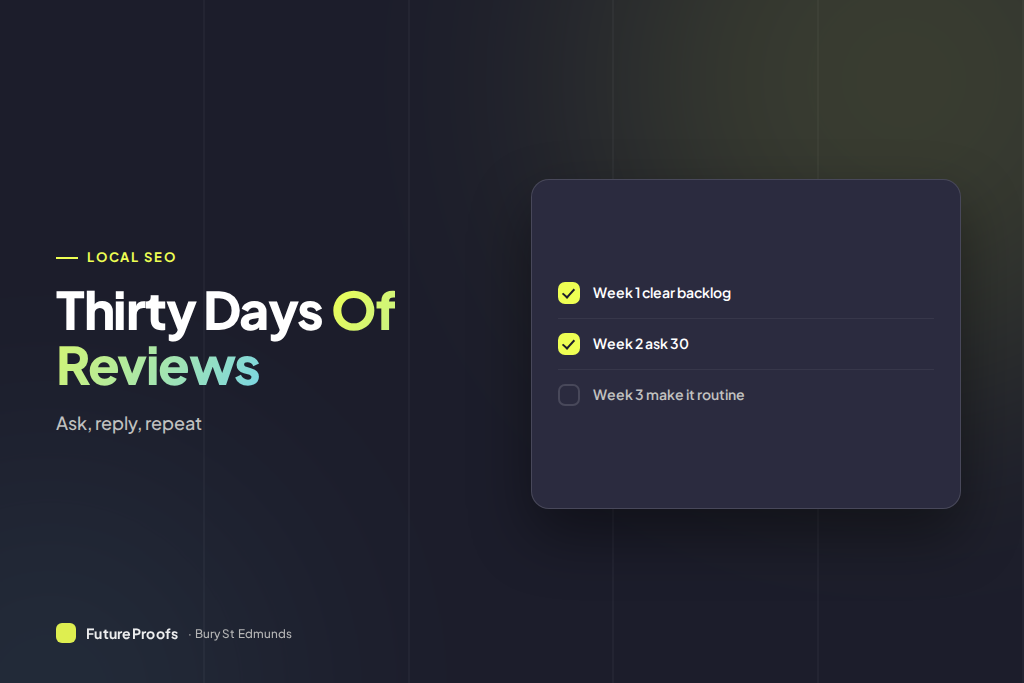
Do this in order. Week one is unglamorous admin, and skipping it is why most review pushes stall in week three.
Week one: clear the backlog and fix the plumbing
Before you ask anybody for anything, spend ninety minutes on the profile. An empty reply column and a wrong category quietly cancel out the work you are about to do.
- Reply to every review you have never replied to. Yes, including the four star one from 2023. It takes an afternoon once and never again.
- Check your primary category. It is the strongest single local pack signal there is. A barber listed as "hair salon" is competing in the wrong race.
- Get your short review link. Open your Business Profile, choose Ask for reviews, and copy the link Google generates. It drops the customer straight onto the star selector. Save it as a note on your phone and as a text replacement so you never hunt for it again.
- Decide who sends the ask. One named person. If it is everyone's job it is nobody's job, and this is where two thirds of review programmes die.
Week two: ask the last thirty customers
Not all at once. Forty reviews landing on a Thursday afternoon from a business that had none for a year is the shape of a bought batch. Send six or seven a day for a week, starting with the customers you actually liked, because they reply fastest.
Week three: attach the ask to the job, not to your memory
The ask has to hang off something that already happens: the invoice going out, the card machine beeping, the appointment being marked complete. A joiner in Rougham who sends the message from the van outside, before driving off, will out-collect one who plans to do it on Sunday evening. For a shop that means a printed card handed over with the receipt, not a sticker by the door everybody has stopped seeing.
Week four: read what you got and use it
By now you should have somewhere between eight and twenty new reviews depending on your customer volume. Read them properly. The words customers keep reaching for are the words your website should be using, and there is a whole second job in getting those reviews onto your website in a form Google and AI assistants can actually read. Collecting them is half. Displaying them is the other half.
Why recency now beats a big pile of old reviews
Whitespark surveys local search practitioners every year and scores what actually moves the map pack. The 2026 edition puts primary Business Profile category top at 227, proximity to the searcher second at 225, keywords in the business title third at 223, a physical address in the search city fourth at 213 and being open at the time of the search fifth at 189.
Review recency comes in eleventh overall at 164. That is higher than most on-page work and considerably higher than citations, which slipped again year on year. Reviews as a signal group rose; directory listings fell. Keywords appearing inside native Google reviews sit much further down at 36th, scoring 117, which is worth knowing before you talk yourself into steering what customers write.
Google has never published a decay curve and anyone who quotes you one is guessing. What the practitioner data shows, and what we see across Suffolk profiles, is that a steady flow reads as a trading business and a frozen wall reads as one that may have shut. Profiles that go quiet in other ways soften too: past a month with no new photos, posts or replies, visibility tends to slip even when nothing else changed.
The practical version: two reviews a month forever beats twenty reviews once.
How do I ask customers for a Google review?
Short, by text, from a human, with the link right there. Every extra step costs you roughly half the responses.
The text message
"Hi Sarah, Dan here from the garage. Glad the MOT and the rear pads are sorted. If you have a minute, a quick Google review really helps us out. Takes about thirty seconds: [link]"
Three things are doing the work. It uses her name. It names the job, which is what stops the review coming back as "great service, thanks". And it sets the time cost honestly, because thirty seconds is believable and "a few minutes of your time" is not.
The email, for when you have no mobile number
Subject: Quick favour, Sarah
"Thanks again for having us in to fit the bathroom last week. We are a small outfit and Google reviews are genuinely how people in Bury and the villages find us. If you have a spare minute, the review box is here: [link]. If anything is not right, reply to this instead and I will come back out."
That last line is not review gating, because nobody is being filtered away from the form. You are giving an unhappy customer somewhere better to go, which is decent and self-interested at once.
The moment to send it
- Trades and home services: as you pack up, or within two hours. Satisfaction with a finished job peaks the day it is finished.
- Salons, barbers, clinics: at the till, verbally, then the text lands that evening. The verbal ask roughly doubles the reply rate on the text.
- Hospitality: on the bill, printed, with a QR code. Nobody is opening a text about last night's dinner.
- Professional services: at the point the client gets the outcome, not when the invoice is settled. Completion day for a conveyancer, not the day the fee clears.
- Ecommerce: five to seven days after delivery, so they have used the thing.
How many Google reviews do you actually need?
Google publishes no threshold. The honest answer is that you need enough to look credible next to the two businesses either side of you in the map pack. Go and look at them; that is your number. The table sets a sensible pace from each starting position.
| Reviews you have now | Monthly target | What that looks like |
|---|
| Under 10 | 6 to 8 | Work the back catalogue. Ask every past customer you are still on good terms with, spread across three weeks. |
| 10 to 40 | 4 to 6 | Every completed job gets asked, no exceptions. This is the stage where the habit either sticks or does not. |
| 40 to 100 | 3 to 4 | Ask selectively and put the effort into replies instead. You are defending recency, not chasing volume. |
| Over 100 | 2 to 3 | Maintenance. The risk is complacency: a profile this size coasts for months before the drop shows. |
One caveat on small numbers: with eleven reviews, a single one star drops your average by roughly four tenths. That is the real argument for volume, insulation rather than ranking.
How to reply to reviews, including the one that stings
Replies do two jobs. They are engagement Google can see, and they are the part future customers read most carefully, because the praise could be your mum and the reply could not.
Replying to a five star review
"Thanks Sarah. Glad the bathroom came in on the original quote, and sorry about the dust on day two, that lintel was worse than it looked. Give us a shout when you get to the en suite."
Ninety seconds. It names the job, admits something small and true, and reads like a person. Compare it with "Thank you for your feedback, we value all our customers", which is invisible to a machine and irritating to a human.
Replying to a three star review
"Appreciate you being straight with us, Mark. You are right that we were two days late starting and we did not warn you early enough. We have changed how we confirm start dates because of this one. If you do give us another go I will run that job myself."
Three star reviews are the most useful ones you will get and the ones owners most want to argue with. Do not. Agree with the bit that is true, say what changed, stop.
Replying to a one star review
"I am sorry, this is not how we work and I would like to sort it. I cannot match this to a job on our system, so if you can email me on [address] or ring the shop I will look into it today. If we have got something wrong we will put it right."
Short. No defence, no timeline of who said what, no comment on the customer's tone. You are not writing to the reviewer, you are writing to the two hundred people who will read this while deciding whether to ring you.
The four things that will cost you
- Incentives. A free coffee, ten per cent off, a prize draw entry. All of it breaches Google's policy whether the review is honest or not, and the usual outcome is the reviews being removed after you have paid for them.
- Gating. Asking customers how it went first and only sending the Google link to the happy ones. It is against policy, it is detectable, and it is also just cheating.
- Buying. Purchased reviews arrive in clusters, share writing patterns and get caught. The penalty runs from removal through ranking suppression to profile suspension, and getting a suspended profile back takes months you cannot afford.
- One reply template used forty times. Identical replies are trivially easy to spot, they read as automated to customers, and they waste the only free engagement signal you have.
There is a fifth, and it is by far the most common one we see in Bury St Edmunds and the market towns around it: not asking at all, on the theory that good customers will get round to it. Unprompted, hardly any do. The people who leave reviews without being asked are overwhelmingly the ones who are cross.
If the asking is the part that will not stick, that is exactly what our review growth system at £95 a month exists to do, and it sits alongside the other fixed monthly growth systems rather than being sold as a project. We ran the same routine as part of a three month local search push for a Peterborough barbershop, where the profile work and the site work were done together rather than in sequence.
Frequently asked questions
How often should I get new Google reviews?
Aim for two to six a month depending on your customer volume, every month, indefinitely. Consistency matters more than the number. A steady trickle keeps your profile reading as an active trading business, whereas a burst of thirty followed by six months of silence leaves you looking stale by the spring and can resemble a purchased batch.
Do Google reviews affect ranking?
Yes, and recency in particular. Whitespark's 2026 practitioner survey ranks review recency eleventh out of all local pack factors, above most on-page signals and well above citations. Reviews will not beat proximity or a correct primary category, which score higher, but between two similar businesses at a similar distance they are frequently the thing that separates them.
Can I ask customers for a review by text message?
Yes. Under UK GDPR and PECR, messaging an existing customer about a service you have just provided them sits comfortably within the soft opt-in, provided you offer a way to opt out. Text also outperforms email in trades, personal care and home services, because it gets opened while the job is still fresh.
How should I respond to a bad Google review?
Reply within a couple of days, briefly, without arguing, and move the detail offline. Apologise for the experience rather than for the review, offer a direct email or phone number, and say what you will do. Future customers read the reply far more closely than the complaint, and a calm one repairs most of the damage.
Can I get a bad Google review removed?
Only if it breaches Google's policies, which cover fake reviews, conflicts of interest, off-topic content, harassment and personal information. A genuine complaint from a real customer will not be taken down, and flagging it as fake when it is not tends to fail and wastes a week. Reply well and outweigh it with fresh ones instead.
Should I use a review request app or do it manually?
Start manually. A saved link and a personal text costs nothing and converts better than most automated sequences, because it reads like a person. Move to software when the volume genuinely stops you keeping up, usually somewhere past twenty jobs a week, and not before you have proved the habit works.
What to do before Friday
Reply to your oldest unanswered review. Copy your short review link into a note on your phone. Text the last five customers you were glad to work for. That is under an hour, and it is the whole method in miniature.
The reason this beats a bigger, cleverer project is arithmetic. In a town the size of Bury St Edmunds most categories have a handful of serious competitors, not four hundred, and the gap between third and fourth in the map pack is often single figures of recent reviews. That is a fight you can win from the van. Reviews also sit inside the wider local SEO picture for a Bury St Edmunds business, alongside your categories, your pages and your site speed.
If you would rather the asking, chasing and replying happened without you thinking about it, that is what our local search work in Bury St Edmunds covers as standard. Tell us what you sell and where you sell it and we will tell you what your review pace needs to be.