Somewhere in an audit you have been sent, or in a sentence from whoever built your site, the words structured data appeared and you nodded. Then a quote arrived with a line item for it. Now you would quite like to know what it is, whether it does anything, and whether £600 is a fair price for something you cannot see on the page.
This is schema markup for small business owners rather than developers. What it actually does, which types matter for a firm in Bury St Edmunds or Ely, what it will not do no matter who sells it to you, and how to check in five minutes whether your site already has any.
The short version, so you can judge the rest against it: schema does not make you rank higher. It makes your page legible to machines, and being legible is what qualifies you for the things that do get you seen.
Key takeaways
- Schema markup is a block of JSON-LD code that states the facts on a page in a form a machine cannot misread: name, address, hours, price, rating, area served.
- Google has been consistent for years that structured data is not a ranking factor; it is what makes a page eligible for rich results and easier for AI systems to quote correctly.
- Five types cover almost every Suffolk small business: LocalBusiness, Service, Review, BreadcrumbList and, for shops, Product with Offer.
- Marking up information that is not visible on the page, or reviews you have not received, breaches Google's guidelines and can trigger a manual action.
- A retrofit onto an existing site typically runs £400 to £900; built into a new site it costs the build team minutes, which is why it should never be a separate invoice line.
What schema markup does, using one real page
Forget the definition for a moment and look at a page. A dog groomer in Stowmarket has a service page. It says she is open Tuesday to Saturday, eight until five, that she covers Stowmarket, Needham Market and Stowupland, that a hydrobath and full groom for a medium breed starts at £45, that she has 137 Google reviews averaging 4.9, and that she is City and Guilds qualified.
What that page tells a person
Everything. A human reads it in fifteen seconds, works out that she is open on Saturday, that Needham Market is covered, and that £45 is a starting price rather than a finishing one. Prose is an efficient format for a reader, because the reader brings the context.
What the same page tells a machine
Much less, and with more room for error. A crawler has to work out whether "from £45" is a price for the service on this page or for something mentioned in passing. It has to decide whether Stowupland is somewhere she works or somewhere she is based. It has to guess whether 4.9 is a rating, a version number or a measurement. Usually it gets this right. Sometimes it does not, and there is no way to tell which pages it got wrong.
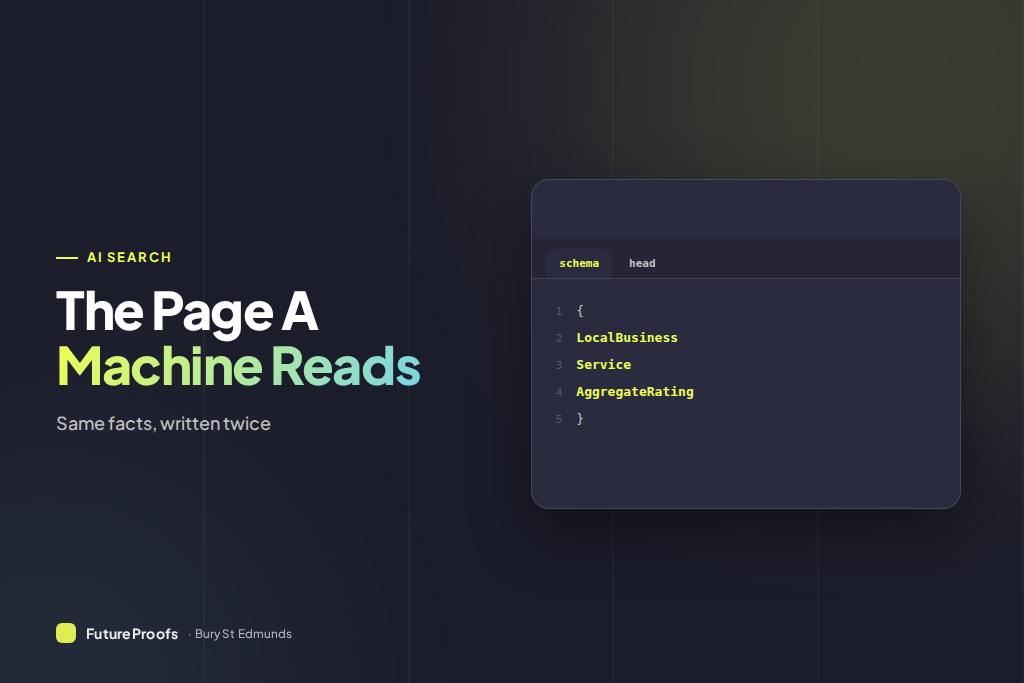
Schema markup removes the guessing. It repeats the same facts in a small block of code that never appears on screen, labelled explicitly: this is a LocalBusiness, its openingHoursSpecification runs Tuesday to Saturday, its areaServed is Stowmarket, Needham Market and Stowupland, this Service has an offer with a price of 45 in GBP, its aggregateRating is 4.9 from 137 reviews. Nothing new is claimed. The same facts are stated in a form that cannot be misread. Markup like this comes as standard with our SEO for Stowmarket businesses.
That is the whole idea. Schema is not a message to Google. It is the same message, written twice, once for people and once for machines.
Is schema markup for small business actually worth it?
Not in the way it is usually sold. Google has said for years that structured data is not a ranking factor, and nothing in 2026 has changed that. Add LocalBusiness markup to a page sitting eleventh and it will still be eleventh next week. Any agency implying otherwise is either careless or hoping you will not check.
What it does do is worth having anyway, and there are three things on the list.
- Eligibility for rich results. Star ratings, prices, stock, breadcrumb paths and event dates only appear if the markup is there. No markup, no eligibility, regardless of how good the page is.
- Entity matching. Google has to be confident that the business on your website is the same business as your Google Business Profile, your Companies House entry and the citation on a directory. Consistent Organization and LocalBusiness markup is a large part of how that confidence is built.
- Reduced ambiguity for anything reading the page. That includes AI systems, but it also includes Bing, aggregators, and whatever comes next.
Notice what is missing. Schema will not rescue a thin page, will not make up for having no reviews, and will not put you in the map pack. It is a foundation, not a lever.
Which schema types should a local business use?
The schema.org vocabulary runs to hundreds of types and almost all of them are irrelevant to you. This is the working list.
| Type | What it states | What it makes possible |
|---|
| LocalBusiness | Name, address, phone, opening hours, area served, price range | Consistent entity matching between your site, Maps and AI answers |
| Service | Each service you offer, who provides it, where it is delivered | A machine can list what you do and where without inferring it from prose |
| Review and AggregateRating | Ratings and reviews you genuinely hold | Star ratings on eligible results, and a checkable trust signal |
| BreadcrumbList | Where the page sits in the structure of the site | The readable path shown under your listing instead of a raw address |
| Product with Offer | Price, currency, availability, condition | Price and stock in shopping surfaces, for anyone selling online |
| Article or BlogPosting | Author, publisher, published and modified dates | Author and freshness signals on content pages |
Most service businesses need the first four and nothing else. A shop adds Product. A site that publishes anything adds Article. FAQPage is a special case now that Google has retired its rich result, and the reasoning behind keeping FAQ markup in place while rewriting the answers is worth reading if you have it on your pages.
One more thing about the table. Every row is a claim you have to be able to stand behind. If your opening hours in the markup say Saturday and your door says otherwise, you have not gained a signal, you have created a contradiction.
How schema feeds AI search, without the magic
AI Overviews now sit on top of roughly a third of UK Google searches, and a growing share of buying research starts in ChatGPT or Perplexity. It is fair to ask where structured data fits.
The honest position is that nobody outside those companies knows the weighting. Google has published no AI Mode schema specification, and the correlation studies circulating in the industry are observational rather than confirmed. Treat any claim of a specific percentage uplift as marketing.
What is defensible is the mechanism. When a model composes an answer to "who does mobile dog grooming near Needham Market", it has to be sure enough of the facts to state them. A page where the coverage area, the price and the rating are all explicitly labelled gives it something it can repeat without risk. A page where those facts are buried in a paragraph gives it something it might get wrong, and systems that might get something wrong tend to reach for a different source. That is why the practical work on answer engine optimisation and the specific tactics for getting cited by ChatGPT both treat markup as the floor rather than the strategy.
How do I add schema to my website?
The format is JSON-LD, a small block of code in the head of the page. Microdata and RDFa still technically work and nobody should be using them in 2026.
On Webflow
Add the JSON-LD block to the page's custom code in page settings, or to the site-wide code for anything that belongs on every page. For CMS collections such as blog posts or service pages, you write the block once in the template and pull the values from the collection fields, so the markup stays correct as content changes. This is the part people get wrong by hand: hard-coded values go stale the first time you update a price.
On WordPress
Yoast, Rank Math and Schema Pro will all generate a basic block, and for a home page LocalBusiness that is a reasonable route. The gaps are consistent. Generated templates routinely omit areaServed, priceRange and aggregateRating, and where two plugins both output an Organization block you end up with duplicate, conflicting entities. Check the output rather than trusting the plugin's dashboard.
How to check it worked
Two free tools, thirty seconds each. Paste the page address into validator.schema.org for a complete list of what is present and whether it is valid. Then run Google's Rich Results Test at search.google.com/test/rich-results to see which of it Google will actually act on. After a few weeks, the enhancement reports in Search Console will show which types Google has detected across the whole site, which is how you catch a template that dropped its markup during an edit.
Roughly four in five existing sites we audit come back with no markup at all, or with a partial implementation that fails validation. It is the most common technical gap we find, and it is usually not because anyone was negligent. It is because nobody ever ran the test.
The mistakes that turn schema into a liability
Bad structured data is worse than none, because it moves you from invisible to wrong. Four failures account for nearly all of it.
- Marking up what is not on the page. Google's guidelines require structured data to describe visible content. Code claiming a price the page does not show is a spam issue, not a clever shortcut.
- Inventing reviews. AggregateRating with figures the business has not earned is the fastest route to a manual action we see, and it is depressingly common on sites built to look established before they are.
- Copying the same block across every location page. If your Sudbury page and your Haverhill page carry identical LocalBusiness markup with the same address, you have told Google they are the same page, which does not help either of them.
- Letting it go stale. Prices change, hours change, a phone number changes. Markup that contradicts the visible page is a signal you would rather not send, and nobody notices because nobody looks at code they cannot see.
The last one is the reason we treat structured data as maintenance rather than a task. On a rebuild like the Cambridge Fireplaces project, the markup was built into the templates so that the values follow the content, and the ongoing search work keeps it honest as the business changes.
What should schema markup cost?
Retrofitting an existing site typically runs between £400 and £900 depending on page count and the state of what is there, with older WordPress builds at the top of the range because of plugin conflicts. That is a fair price for real work on a site not built with it.
Building it into a new site costs the build team minutes, because the templates are being written anyway. That is the argument against paying for it as a separate line item. Every site we build ships with the markup in place as part of the standard build, and it is maintained inside the same monthly figure rather than quoted for, which you can see in plain numbers on the pricing page.
If someone is quoting you four figures for structured data alone on a five page site, ask them which types, on which pages, and how they will demonstrate it validates. A straight answer takes ten seconds. Anything vaguer than that is a reason to keep looking.
Frequently asked questions
What is schema markup in plain English?
Schema markup is code that restates the facts on a page in a labelled form machines can read without interpreting prose. It sits in the page source, usually as JSON-LD, and never appears on screen. It says explicitly that this string is an address, this number is a price in pounds, these hours are opening hours, and this rating comes from this many reviews.
Does schema markup improve Google rankings?
No. Google has stated repeatedly that structured data is not a ranking factor, and adding it to a page will not move its position. What it does is make the page eligible for rich results such as star ratings and prices, and make its facts unambiguous to search engines and AI systems, both of which affect how often the listing gets clicked.
Which schema types does a small business actually need?
Four types cover most service businesses: LocalBusiness, Service, Review with AggregateRating, and BreadcrumbList. Shops add Product with Offer for price and availability, and any site publishing articles adds BlogPosting with an author and dates. The remaining hundreds of schema.org types are irrelevant to a typical firm in Suffolk or Cambridgeshire.
How do I add schema markup to my website?
Write it as JSON-LD and place it in the page's head, either through your platform's custom code area or a plugin. In Webflow, put the block in page settings and pull values from CMS fields so it updates with the content. In WordPress, an SEO plugin generates a basic version that usually needs manual completion. Validate before you consider it done.
How do I know if my schema is working?
Run the page through validator.schema.org for a full list of detected types and errors, then Google's Rich Results Test to see what Google will act on. After a few weeks, the enhancement reports in Search Console show which types have been detected across the site, which is the quickest way to spot a template that lost its markup during an edit.
Do I still need schema if I have a Google Business Profile?
Yes, because they do different jobs. Your Business Profile drives the map pack and Google's local listings. Schema markup describes your website to search engines, AI systems and anything else parsing the page. Google prefers the two to agree exactly on name, address, phone and hours, so treat them as one set of facts published in two places rather than alternatives.
Where to start if your site has none
Run the validator on your home page and one service page. That is the whole first step, and it takes less time than reading this paragraph. If it comes back empty, you now know the size of the job, and it is smaller than it sounds: a handful of types, on a handful of page templates, describing facts you already publish.
Do the home page first with LocalBusiness, and make every value match your Google Business Profile character for character. Then the service pages. Then reviews, once you actually have them, and never before. Everything else can wait until the basics validate cleanly, because a small correct implementation beats a sprawling broken one every time.
Schema is not exciting and it is not a growth tactic. It is the difference between a machine knowing what your business is and a machine guessing. If you would like to know what your site currently publishes, send us the address and we will run the validator and tell you what is missing.